The ledger nobody keeps
Public forecasts arrive with a name, a date and an outcome anybody can look up. No practitioner keeps the page that records how they came out.
Two ways in. The gist assumes you have never met any of this before.
The ledger this trade has never kept would be a dull document, and a short one. One line for each public forecast. What was said, in words exact enough that they could turn out false. Where it appeared and on what date, fixed before the event. What actually happened. A mark in the last column: right, wrong, or too vague to score. At the foot of the page a running total, added up by somebody with nothing riding on the answer.
A clerk could keep it in an afternoon a month. I have not found one. Not for any named astrologer in this country, not for any television panel, not on any platform that sells readings by the minute. What exists is the forecast, published, dated, with a name on it, and then nothing.
The public forecast is a different article from the paid reading I usually write about. Nobody buys it, it is addressed to whoever happens to be looking, and it fastens itself to a dated event anyone can look up: a count of votes, a film's opening weekend, a match. Everything a scorer needs is already on the record with names attached. That makes this the easiest marking job in the discipline, and the one nobody does.
Take the plainest case available, and take it as a composite. What follows is the shape of what got published, not any one page and not any one person.
In the days before the cricket World Cup final of 19 November 2023, forecasts went up on Indian news sites and astrology pages saying India would take the trophy. Some were dated the day before the match. Some had been through the players' charts, some named a favourable hour, some carried nothing but the conclusion. Names were attached, because a public forecast without a name is not worth printing.
Australia won by six wickets. Pat Cummins took the toss and put India in; India made 240 in their 50 overs, and Australia passed the target inside 43 overs.
I am not accusing anybody of anything. Whoever said in public, under their own name, what they thought would happen did more than most of this trade ever does. The point is the missing page. Every ball of that final sits in a public scorecard, the forecasts and the result stand one day apart on the same websites, and I could not find the piece that set the two side by side.
Then watch how a practitioner gets introduced the next time, because the mechanism is in the introduction. The astrologer who predicted the 2011 win. A sentence in that form is available only because nobody keeps the other column. A hit becomes a credential. A miss becomes nothing, since there is no page for it to be written on.
What happens to a miss
The largest public forecast in this country's memory came with a minute attached to it.
In early February 1962 the sun, the moon and the five visible planets crowded into about 16 degrees of sky, in the stretch this tradition counts as Capricorn. An eclipse fell in the same window, the moon meeting the sun at the crossing of their paths. Eight bodies in one place, by the count everyone repeated. Astrologers said the world would end, and a great deal of the country believed them. Time reported 400 priests working day and night in bamboo structures near Delhi, feeding fires with ghee under television lights.
The hour passed. Nothing happened.
Accounts do not even agree on which hour it was. Time, reporting that week, put the grouping at 5.47 in the evening Indian time on 3 February; the retellings in Indian papers since give 5.38 on the evening of the 5th. Sixty years on, the most famous forecast in the country cannot be fixed to a day.
A miss of that size, at a named minute, in front of a whole country, ought to be the heaviest entry any ledger could hold. Instead two things were done with it, and both are still in service.
The first was to credit the response. The disaster was averted, it was said, because so many people had prayed. The forecast survives intact, the remedy takes the credit, and nothing is left that could be scored either way.
The second is slower and matters more. The window was widened afterwards. In 2020 an astrological journal ran a piece offering February 1962 as a case where the configuration did its work: eight planets in Capricorn, and by that October India was in a war with China. The evening of the 5th is not mentioned. Neither is the minute.
I do not think that is usually deliberate. It is what a claim does when no page holds it still. The forecast was made for one evening. The evidence offered for it 58 years later is a war eight months later. In a ledger the entry closes on 6 February and the last column says wrong. Without one it never closes, and can be filled in from whatever the decades supply.
The other public genres run on the same slack. A film has a release date and weekly box office figures, so a forecast about it could be settled inside a week, and is not. An election has a count, and results night deserves an essay to itself. Not this one.
Three parties, no conspiracy
So why does nobody keep the page?
Partly because a published rate can only go down. A practitioner who has never put out a number is sitting, in the reader's mind, on a perfect one, assembled from the hits that made headlines and the misses nobody wrote down. Publishing a real figure trades an imagined record for a finite one. That is the same absence I went after in the guarantee nobody has to keep: a promise with nothing attached that anybody could be shown to have broken.
Mostly, though, because the forgetting has three authors and each has an ordinary reason. The astrologer, obviously. The outlet, which took its traffic on the 18th and has no use for a piece on the 20th reporting that the people it quoted were wrong, since such a piece is an admission about its own page. And the reader, who wanted something to read the night before a final and has a life to get on with. Amnesia at this scale needs no conspiracy. It needs only that nobody is paid for remembering.
Scoring of this kind does get done, by people who set out to disprove the thing, and I do not think it fills the gap. A record kept by an opponent is read as an attack, and the compiler chose the entries. The only ledger worth much is the one kept by the person making the claims.
What an honest one looks like
The best worked example of a field deciding to mark itself is not in this discipline at all.
In March 1884 an American army sergeant named John Park Finley began issuing tornado forecasts twice a day for 18 districts east of the Rocky Mountains, and then did the unusual thing. He published his results, claiming correctness above 95 per cent for the first three months.
Then somebody went through the table. On the full published run of 2,803 forecasts, Finley was right 96.6 per cent of the time. A clerk who wrote "no tornado" on every form every day, without once looking out of the window, would have been right 98.2 per cent of the time. That second figure comes off Finley's own sheet: 2,752 of those 2,803 days had no tornado in them.
There is the whole of forecast verification in one sentence. A score means nothing until you know what the laziest available rule would have scored on the same list. The argument that followed ran for decades and built a discipline out of the question. Weather forecasting is trusted today, inside known limits, because it has spent well over a century publishing how often it is wrong.
So an honest jyotiṣa (ज्योतिष) ledger needs five columns and not four. The claim, written so that it could fail. Where and when it was published, fixed before the event. What happened. The mark. And the base rate: what a person saying the obvious thing would have scored on the same list. Without that last column those November forecasts tell you nothing about anybody's method. India had won all 10 of their matches in that tournament. India will win was the expected sentence in every tea shop in the country, and a correct call at short odds is worth very little.
Ankit has set out what we hold ourselves to inside a single reading in what an honest reading looks like. A ledger is that idea carried outside the room. We have said we will publish ours, and until the file is up that is a promise and not a ledger.
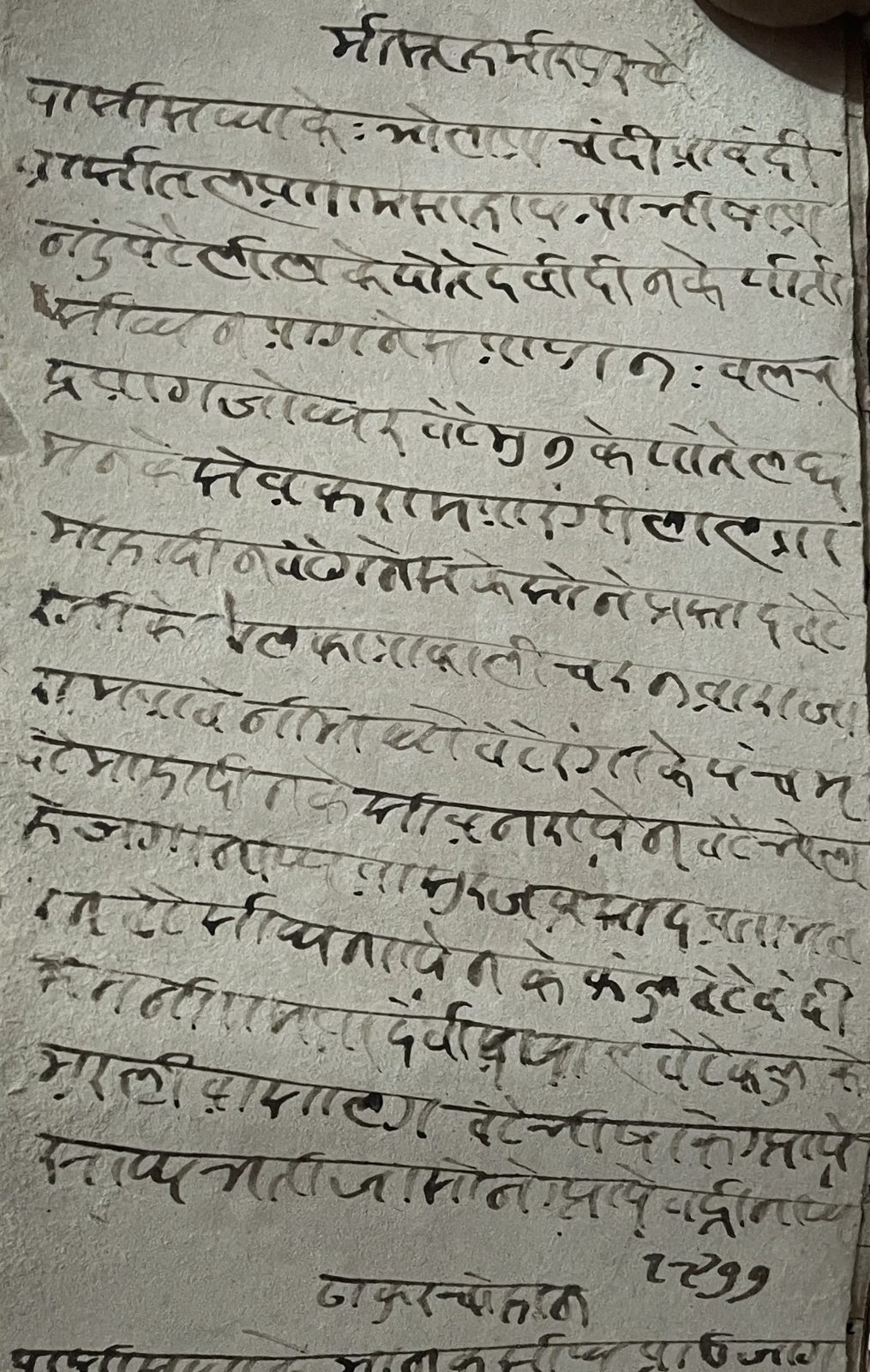
Haridwar keeps registers. The pandas there hold bahīs (बही), family books written up when a household comes to perform its rites: the names, the village, the date, one generation under the last, in ink, so that a person can walk in long afterwards and find the page an ancestor signed. Generations of arrivals, in handwriting, kept against the day somebody comes looking.
Nothing about that is difficult, and none of it needed a system. It is what recording looks like in this country once a thing has been decided to be worth recording, and it is done by hand. The forecasts are not going unrecorded for want of a method.
Twice a week
Essays like this one, Tuesdays and Saturdays. One email per essay, and the archive is never mailed out. Subscriptions open shortly; the RSS feed is live now.
Nothing else arrives, ever.