Nakshatra files · Yamini Sardesai
Uttara Ashadha: the later victory
Nunki, the star of the twenty-first station, carries a Sumerian word that outlived its language. The later half of a pair, and endurance as a kind of winning.
Two ways in. The gist assumes you have never met any of this before.
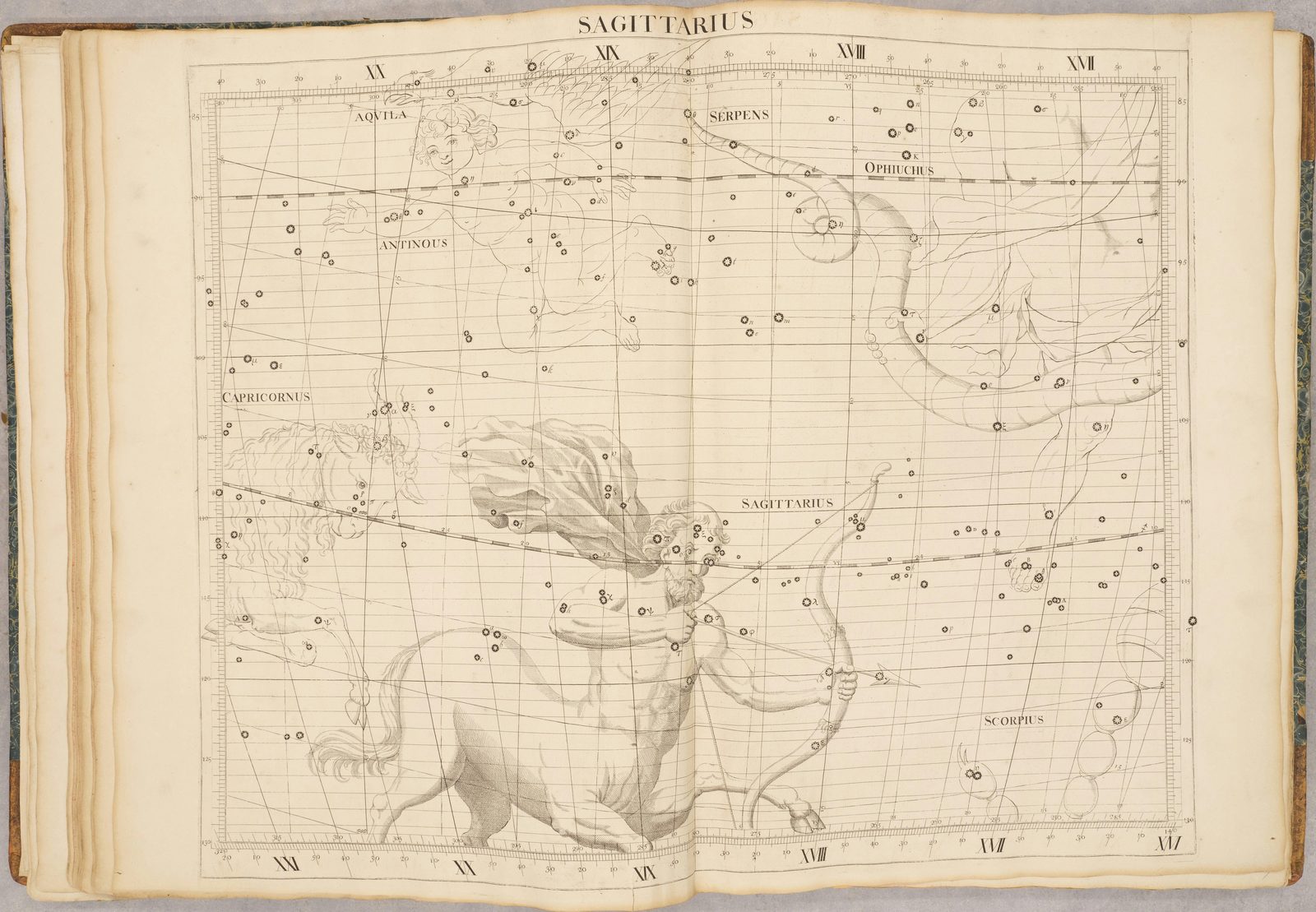
Uttarāṣāḍhā (उत्तराषाढा) is the later half of a name it shares with the station next door, and on a clear October evening the sky performs the split for you: the earlier station's stars go under the western horizon first, and this one's follow about three quarters of an hour behind, in that order, every night of the season. It is the twenty-first of the twenty-seven nakṣatra (नक्षत्र), the lodgings the moon works through at about one a night.
Take the sky first, because the sky is where the station keeps its promise.
Go out in the first week of October, once the light has finished draining, and face south. Sagittarius is already past the meridian and leaning west, the whole teapot of it tipped over towards the horizon it is about to go through. The bow at the western end of that shape was the previous file's business and I will not walk it again. The arrow is one star, gamma Sagittarii, at the very tip of the spout, and the series has not stopped on it before: the catalogues call it Alnasl, from the Arabic for an arrowhead. Take it now, because you will want it at the end. What matters otherwise is the handle at the eastern end, two stars standing apart from the rest and holding their own small distance from each other.
The upper one is Nunki, sigma Sagittarii, magnitude 2.05, which on the backwards brightness scale makes it the brightest thing in Sagittarius except the bright end of the bow. It is a hot blue-white star about 225 light years off, and it turns on its axis at 165 kilometres a second or faster. That figure is the speed measured across our line of sight, so it is a floor rather than the rate itself, and even the floor is roughly eighty times the pace of the sun's own surface. Below it and a little east sits Ascella, zeta Sagittarii, magnitude 2.59, the third brightest thing in the constellation and much nearer at about 88 light years. Ascella is not one star. It is three, an inner pair going round each other in about a month and a third star working round both of them in twenty-one years.
Now the heights, which are the reason this station is easier to keep than its neighbour. From Delhi, Nunki crosses due south at about 35 degrees up. The low star of the bow crosses at 27, which is the difference between a star you can find over a rooftop and a star you need a clear field for. In the first week of October the crossing itself happens around sunset, so you never see this station climbing. You meet it already on its way down.
Which brings us back to the claim at the top of this file, and here is the working behind it. On the evening of 6 October, from Delhi and over a flat horizon, the two stars of the bow go under at about twenty past and half past ten. Nunki and Ascella follow at about a quarter past eleven. Three quarters of an hour, near enough. The earlier station sets earlier and the later station sets later, which is the plainest thing a name has ever been asked to do, and nobody had to arrange it.
A word with no country
Nunki is not Sanskrit, not Greek, not Arabic, not Latin. It is a reading of two cuneiform signs, NUN.KI, which in Sumerian write the name of the city of Eridu in the far south of Mesopotamia. Eridu was building itself before 5000 BC and was abandoned around 600 BC, when the irrigation that had fed it left too much salt in the ground. The signs outlived the city, and then outlived the language, and then outlived the whole writing system.
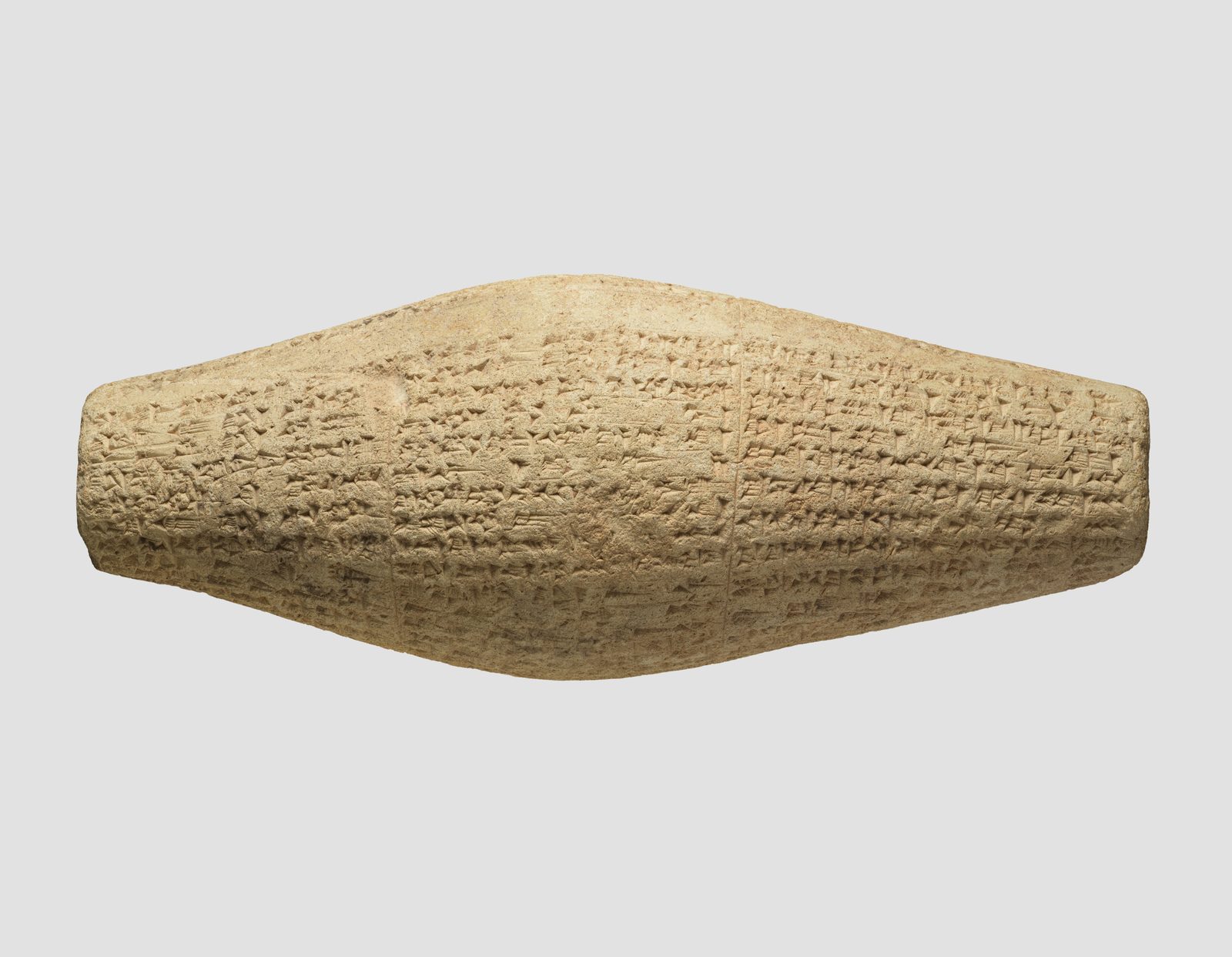
They reach modern charts through one book. R. H. Allen's Star-Names and Their Meanings, published in 1899 and still in print as Star Names: Their Lore and Meaning, the title Dover put on the 1963 reissue, is the compendium that most English star lore still runs on, and Allen identified sigma Sagittarii with a Nunki he had found in what he called the Euphratean Tablet of the Thirty Stars, glossing it, in his own words, as "the Star of the Proclamation of the Sea". That phrase has been repeated for a hundred and twenty-odd years.
It is very probably wrong. Scholars who work on the actual cuneiform star lists have refined those nineteenth-century identifications a great deal, and the current view is that MUL.NUNki, the star of Eridu, was not this star at all. The best candidate is Canopus, far to the south, which would have risen into view from Eridu's latitude as precession slowly tilted the sky. So what we have is a real word from a real place, applied to a star it may never have meant, on the authority of a book written in New England by a man reading translations.
The International Astronomical Union made it official on 21 August 2016, the same day it fixed the two claws of the sixteenth station into the catalogues. Ascella followed on 12 September of the same year, and Ascella is the corrective this station needs, because Ascella is Late Latin for armpit. That is where the star sits on the old drawings of the archer, and the naming committees kept it. One half of the handle carries a word from a drowned city and the other half is a body part nobody mentions in a speech.
Former and latter
The list of twenty-seven splits three of its names between two stations each, an earlier and a later: the two Phalgunis, the two Bhadrapadas, and the pair we are standing in. That is six of the twenty-seven spent on three names. Pūrvāṣāḍhā is the former Ashadha and uttarāṣāḍhā is the latter one, exactly as the two beds of the Phalguni pair divide between them.
What they share is the second half of the word, and it is a boast. The dictionaries take āṣāḍhā from a negative prefix and a root meaning to overcome, so the sense is not to be overcome, unconquered, invincible. A pair of stations that between them cover nearly a month of the moon's year, and their common name is a refusal to be beaten.
Split a boast in two and the halves do not carry equal weight. The former Ashadha gets the declaration. The latter one gets what happens afterwards, which is the same claim made again on a night when nobody is checking. That is not a smaller thing. Anyone who has watched a project through its second year knows which half is harder, and it is not the half with the announcement in it.
The tradition put something else in this gap, and it is worth one line. Between this station and the next, some reckonings insert a twenty-eighth, Abhijit, which survives in the almanacs as a window of time around noon rather than as a patch of sky. Priya has done that arithmetic and I am not going to redo it here.
Nobody's name on it
The presiding figure of this station is not a figure. It is the Viśvedevāḥ (विश्वेदेवाः), the all-gods, a collective the hymns address as a body when they want everyone included and nobody singled out. Other stations get a named power: a king, a craftsman, a serpent, an ancestor. This one gets the whole assembly at once.
Set that beside the boast and the shape of the station comes clear. A victory is being claimed, and there is no protagonist to hang it on. Whatever was won here was won by a committee, and nobody in the story gets the statue.
The handbooks turn this into a paragraph about Uttara Ashadha people being patient, principled and bound to succeed in the long run. Take that as loosely as it deserves. The chart put the moon in a slice of arc thirteen degrees and twenty minutes wide for something under a day, and the character sketch was written later, by a person, from a name. Handbooks also draw an elephant's tusk beside this station, and a tusk is a thing that grows slowly and does not stop.
Still, the material underneath the sketch is not nothing, and it asks a better question than the sketch does. Not what am I like. What did I finish this year, counted against what I started. And the harder one, which is about the all-gods rather than about me: when something I built finally worked, who was still in the room. Some of them will have been there since the announcement, which is easy to forget, because the announcement is the part that got remembered.
So go up on the roof on a clear night in the first half of October and stay longer than you meant to. Find the tipped teapot in the south-west, take the two handle stars, the whiter one above and the triple one below, and then simply wait while the bow goes down. Alnasl at the spout tip goes under first, then the two bright stars of the bow behind it, and the handle is left standing there with nothing beneath it, for three quarters of an hour, which is long enough to get cold. Then they go too, and you can come in. You will have been the second-last thing to leave.
Twice a week
Essays like this one, Tuesdays and Saturdays. One email per essay, and the archive is never mailed out. Subscriptions open shortly; the RSS feed is live now.
Nothing else arrives, ever.