Computed sky · Meghnad Chitnis
All sixteen vargas in one line of arithmetic
One longitude pushed through all sixteen divisional charts, one line of arithmetic each, and a close look at the four divisions that refuse the formula.
Two ways in. The gist assumes you have never met any of this before.
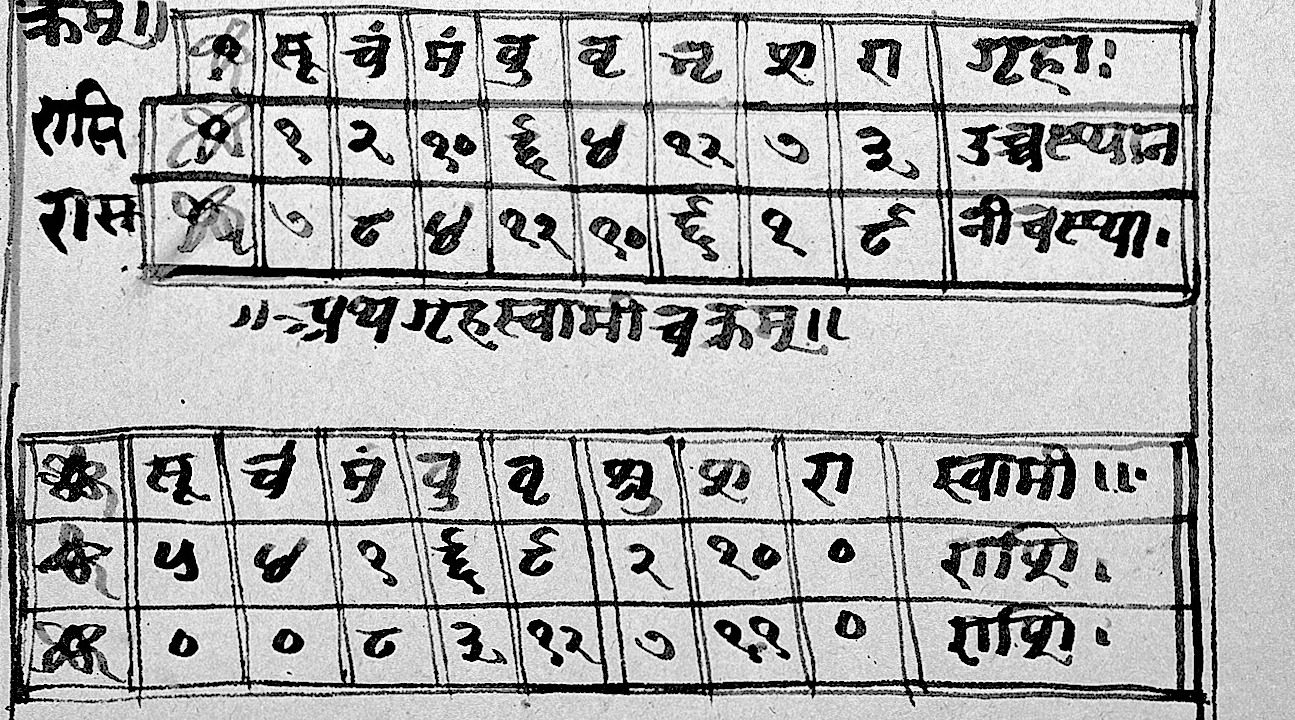
Sixteen divisional tables sit at the back of most jyotiṣa manuals, and 12 of them are the same line of arithmetic with one number changed. Four are not. This page runs a single planetary longitude through all 16 divisions, one line each, and then takes the four refusers apart to see exactly what each of them breaks.
A varga (वर्ग, varga) is a chart made by cutting every sign into equal parts and giving each part a sign name. The set of 16 that the Parashara corpus lists in its chapter on the divisions, the shodashavarga, runs: rashi, hora, drekkana, chaturthamsha, saptamsha, navamsha, dashamsha, dwadashamsha, shodashamsha, vimshamsha, chaturvimshamsha, saptavimshamsha, trimshamsha, khavedamsha, akshavedamsha and shashtiamsha. The names are just the Sanskrit numbers. The counts of parts are 1, 2, 3, 4, 7, 9, 10, 12, 16, 20, 24, 27, 30, 40, 45 and 60.
Now the rule, in words first. A rāśi (राशि), a sign, is 30 degrees, which is 1,800 arcminutes. Cut it into n parts and each part is 1,800 / n arcminutes wide. Take your planet's position inside its own sign, in arcminutes, and see how many whole parts lie behind it; call that count j. Then go to a sign the convention names, count j signs onward from it, and reduce the count by 12.
varga sign = (start + j) mod 12, where j = floor(offset ÷ (1,800 / n))
That is the whole of it, and it has exactly one free parameter: the start sign. Everything a manual prints about a division other than its n is a statement about where the counting begins. The navamsha is this rule with n = 9, and worked in full elsewhere on this site; I will not do it again here.
One longitude, sixteen times
Take a planet at sidereal longitude 221° 45′. That is Scorpio, 11° 45′ into the sign, so the offset is 705 arcminutes. Scorpio is convenient because it is an even sign, a fixed sign and a watery sign at once, and those are the three ways a convention can sort the signs. They will not agree with each other, which is what makes the free parameter visible.
| Varga | n | One part | Parts behind | Count from | Sign |
|---|---|---|---|---|---|
| Rashi | 1 | 30° | 0 | Scorpio | Scorpio |
| Hora | 2 | 15° | 0 | refuses | Cancer |
| Drekkana | 3 | 10° | 1 | refuses | Pisces |
| Chaturthamsha | 4 | 7° 30′ | 1 | refuses | Aquarius |
| Saptamsha | 7 | 4° 17′ 09″ | 2 | Taurus | Cancer |
| Navamsha | 9 | 3° 20′ | 3 | Cancer | Libra |
| Dashamsha | 10 | 3° | 3 | Cancer | Libra |
| Dwadashamsha | 12 | 2° 30′ | 4 | Scorpio | Pisces |
| Shodashamsha | 16 | 1° 52′ 30″ | 6 | Leo | Aquarius |
| Vimshamsha | 20 | 1° 30′ | 7 | Sagittarius | Cancer |
| Chaturvimshamsha | 24 | 1° 15′ | 9 | Cancer | Aries |
| Saptavimshamsha | 27 | 1° 06′ 40″ | 10 | Capricorn | Scorpio |
| Trimshamsha | 30 | unequal | refuses | refuses | Virgo |
| Khavedamsha | 40 | 45′ | 15 | Libra | Capricorn |
| Akshavedamsha | 45 | 40′ | 17 | Leo | Capricorn |
| Shashtiamsha | 60 | 30′ | 23 | Scorpio | Libra |
Every row of that table except four is one division and one addition. The akshavedamsha line, for instance: 1,800 / 45 = 40 arcminutes a part, and 705 / 40 is 17 with 25 left over, so 17 whole parts lie behind the planet; Scorpio is fixed, so the count starts at Leo; and 17 signs on from Leo, reduced by 12, is Capricorn. Anyone with a sheet of paper can check the other rows the same way.
The starts group into four families. Three divisions count from the sign itself (rashi, dwadashamsha, shashtiamsha). Four sort the signs by parity: the saptamsha counts from the sign in an odd sign and from the 7th in an even one, the dashamsha from the sign or the 9th, the chaturvimshamsha from Leo or Cancer, the khavedamsha from Aries or Libra. Four sort by movable, fixed and dual: the navamsha from the sign, the 9th or the 5th, and the shodashamsha, vimshamsha and akshavedamsha from three named signs each. One sorts by element: the saptavimshamsha counts from Aries, Cancer, Libra or Capricorn as the sign is fiery, earthy, airy or watery.
Half of those starts are not an extra convention at all. Forget the sign boundaries and number the parts continuously from the first point of Aries, then reduce by 12: the sign that opens sign number s is n × s mod 12, with Aries as zero. For n = 7, 9, 16, 20 and 27, and trivially for n = 1, that expression reproduces the printed starts exactly. Shodashamsha, n = 16, Taurus, s = 1: 16 − 12 = 4, which is Leo, and Taurus is a fixed sign, and the text says fixed signs begin at Leo.
It also explains why the families are what they are. The sequence n × s mod 12 repeats with a period of 12 divided by the greatest common divisor of n and 12. For 16 and 20 that divisor is 4 and the period is 3, which is exactly the movable, fixed and dual sort. For 27 the divisor is 3 and the period is 4, which is the four elements. For 7 the divisor is 1 and every sign gets its own start, but the distance from a sign to that start has period 2, and so the text states it as odd and even. Each rule is printed in whichever of the two forms is shorter. Varahamihira's statement of the navamsha, that the signs open with the navamshas of Aries, Capricorn, Libra and Cancer, is the same effect at n = 9, and the arithmetic behind it is set out in the earlier essay.
The other six starts (dashamsha, dwadashamsha, chaturvimshamsha, khavedamsha, akshavedamsha, shashtiamsha) do not fall out of the count. Somebody chose them.
The four that refuse
The hora (होरा) breaks the rule at the far end. Its two halves of a sign go to Leo and Cancer, the Sun's sign and the Moon's, and to no other sign ever. There are 24 cells in the zodiac and two names between them. No count of one part from any start can do that, because a count lands anywhere in 12.
The drekkana (द्रेक्काण) and the chaturthamsha (चतुर्थांश) break it in the same place as each other. The three thirds of a sign are the sign, the 5th from it and the 9th; the four quarters are the sign, the 4th, the 7th and the 10th. Those are counts with a step of four signs and of three signs. Note that 12 / 3 = 4 and 12 / 4 = 3: in both cases the step is 12 / n, which is what spreads n parts evenly around the ring instead of packing them consecutively. So these two are one rule rather than two, and it is a rule that can only exist where n divides 12.
The trimshamsha (त्रिंशांश) refuses hardest. Its 30 degrees are not cut into 30 anything. They are cut into five arcs of 5, 5, 8, 7 and 5 degrees, given to Mars, Saturn, Jupiter, Mercury and Venus in an odd sign and to the same planets in reverse order in an even one. Five cells, unequal, and assigned to planets rather than to signs; a sign appears only afterwards, by taking the odd or the even house of the planet named. Our planet stands 11° 45′ into Scorpio, which is even, so the arcs run Venus 5, Mercury 7, Jupiter 8, Saturn 5, Mars 5, and 11° 45′ falls inside Mercury's seven degrees. Mercury's even house is Virgo. Varahamihira gives those five numbers in the first chapter of the Brihat Jataka, and they have stayed 5, 5, 8, 7 and 5 ever since.
Four, then, and not three, which is the figure I had been carrying.
The last thing worth saying is that at least one of the four was arguable. In the very next stanza after he sets out the drekkana as the sign, the 5th and the 9th, Varahamihira records that Garga and his school held otherwise: that the two horas belong to the sign and the 11th from it, and the three drekkanas to the sign, the 12th and the 11th. He does not take that view. Look at what the losing option actually is. Garga's hora keeps all 12 sign names instead of two, which is the general rule at n = 2 with a start, and would not refuse at all. Garga's drekkana is milder than the winning one without being tame: its three parts are consecutive signs rather than four apart, so the step is one sign, but the count runs backwards, and the rule as I stated it counts forward. That one still refuses, less loudly.
So at least one of the exceptions is not a deeper fact about its division. It is the record of an editorial decision taken before the sixth century, with the option that lost printed in the stanza next to the option that won. Anybody minded to argue the scheme should be tidier is in company that is about fifteen centuries old.
Twice a week
Essays like this one, Tuesdays and Saturdays. One email per essay, and the archive is never mailed out. Subscriptions open shortly; the RSS feed is live now.
Nothing else arrives, ever.