Nakshatra files · Yamini Sardesai
Chitra: the jewel that is two stars
The dictionaries give the fourteenth station one star. The star is Spica, and Spica is two, four days apart in orbit and never once seen split.
Two ways in. The gist assumes you have never met any of this before.
Chitrā (चित्रा) is the fourteenth of the twenty-seven nakṣatra (नक्षत्र), the arcs of sky the moon works through at about one a night, and the old dictionaries describe it as an arc with a single star in it. The star is Spica, and Spica is two.
Most of the other lodgings hand you a shape to trace: a triangle, a hook, a box, half a bed. This one hands you one point of light in a poor stretch of sky, which changes the kind of attention it wants. A stone comes to a bench and is turned over: the weight, the colour, the flaw, the setting, and last the mark of whoever made it. Chitra will take all five.
Getting it into your hand is easy. Find the Saptarishi, the seven stars the West calls the Plough. Three of them make the handle, and the handle is a curve. Carry that curve on past the end of it and the first bright star you reach is orange Arcturus; keep going the same way about as far again and you arrive at a white star standing more or less alone. That is Spica. Arc to Arcturus, spike to Spica, and it works the first time you try it.
The station before this one, a small clean box of four stars, lies a little under two fists to Spica's right and slightly down. It borrowed her as a signpost; now she gets her own file.
Then the honest business of when, and here the door is wide. Spica belongs to spring and early summer evenings. From Delhi it stands due south and highest a little after ten at night in the middle of May and around eight in the middle of June, near enough to when the sky finishes going dark, about fifty degrees up at that moment and nearer sixty-five from Chennai. After that the year closes it down: by mid-August it is setting before ten, and by mid-September it is gone within an hour of sunset. Around the middle of October the sun passes some two degrees north of it and there is nothing to go out for. It is back low in the east before dawn from about the middle of November, gaining two hours a month, until by mid-April it is highest near midnight again. Those hours are Delhi's, and unlike anything to do with the moon they come back in the same weeks every year.
Now the weight, and the colour with it. Magnitude 0.97, on the scale that runs backwards, where a smaller number means a brighter star: the sixteenth brightest in the night sky. Two hundred and fifty light years off, give or take ten. Blue-white, because the surface of the brighter member runs near twenty-five thousand degrees where the sun's is under six thousand, and heat that high burns blue. It puts out around twenty thousand times the sun's light.
Then the flaw, and in this stone the flaw is the whole point.
Spica is two stars going round each other every 4.0145 days. The brighter weighs about eleven times as much as the sun. The other weighs about seven, and on its own, anywhere else, that would still count as a large star. The gap is roughly an eighth of the distance from the earth to the sun, near enough twenty million kilometres. Put that pair where the sun is and both would sit well inside the orbit of Mercury.
Twenty million kilometres at two hundred and fifty light years is not much of an angle. Do the division and it comes out at under two thousandths of a second of arc. A second of arc is one three-thousand-six-hundredth of a degree. The full moon is half a degree wide. So the two stars stand about a millionth of a moon's width apart as you look at them. Point any telescope at that and you still get one point. Nobody has ever seen this pair.
So it was not found by looking. It was found inside the light. Send starlight through a spectrograph and it spreads into a band with dark lines ruled across it, each line belonging to a known element at a known place. If the source is coming towards you the whole set shifts one way; going away, the other. In Spica the lines come out doubled, and the two sets slide past each other and merge and part again on a four-day cycle. Two objects taking turns to swing towards us. That is the whole of the evidence, and it is enough.
The stone was gauged all the same, though no picture came out of it. Between 1966 and 1970 an intensity interferometer at Narrabri, in New South Wales, was turned on this star and measured the disc of the brighter member: nine ten-thousandths of a second of arc across. A size taken off an object nobody can see the shape of.
The stone is not round either. The two are close enough that each pulls the other out of shape, so the brighter one is an egg with its long axis pointed at its companion, and as the pair turns you see it now end-on and now side-on. The brightness rises and falls by about three hundredths of a magnitude on the same four-day beat as the orbit. No eye will catch it. Under that runs a faster tremor: the bright star swells and shrinks on its own account every four hours and ten minutes. One point of light, two clocks inside it, neither of them yours.
Then the setting, which for a jewel decides where it can be worn. Spica sits about two degrees from the ecliptic, the line the sun keeps to, and the moon strays some five degrees either side of it. More than once in these files the star a station is named for has turned out to stand well back from the moon's road. Not here. The moon covers this one outright, in runs of months that then stop for years while its tilted path swings away.
The star holds one more post, and it is a peculiar one for a star to hold. A sidereal zodiac has to be pinned to something, and the reckoning most Indian software uses pins it here, holding Spica at 180 degrees of the circle, which is why it is called Chitra-paksha, the Chitra side; what that choice does to your moon sign is worked out properly elsewhere.
Last, the maker's mark.
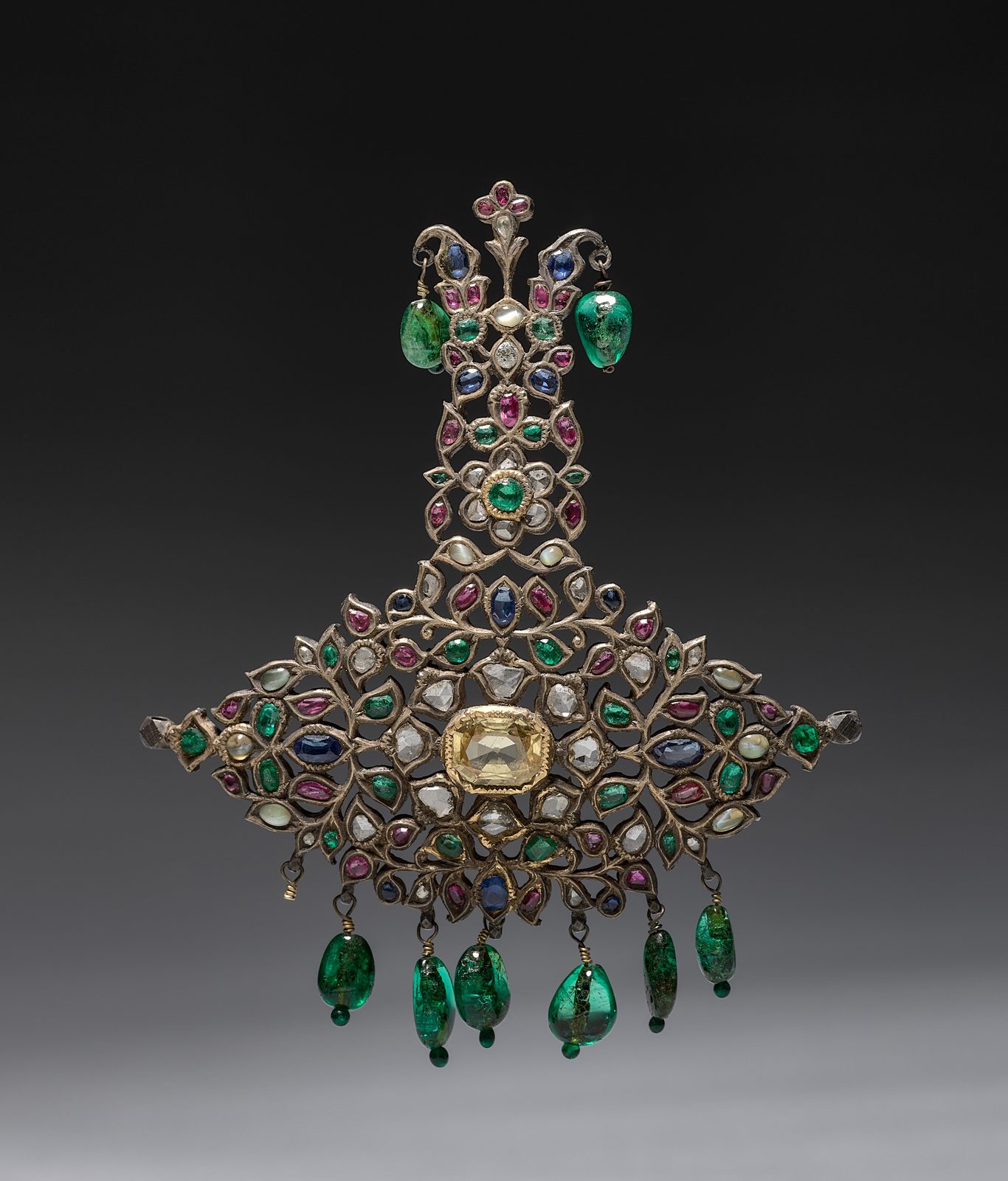
The presiding figure is tvaṣṭṛ (त्वष्टृ), and the name is built on a verb meaning to pare, to fashion, to shape a thing by taking material off it. Monier-Williams gives the everyday sense first, and the everyday sense is a carpenter, a maker of carriages. Then the divine one: the heavenly builder, who made Indra's bolt and Brihaspati's axe and the cup the gods drink from. Then a third that the toolmaking does not prepare you for. He is the former of the bodies of men and animals. The hand that turned out the weapons also shapes what is in the womb. Later material folds him together with Vishvakarman, the architect of the world. The symbol drawn beside this station is a jewel, and sometimes a pearl.
He has one more line in the family register. Saranyu, who married the sun and then went away from him in the form of a mare, is his daughter, and the twins at the head of this whole list came out of that flight. I hand that over as a pleasure, not a doctrine.
The name is the same argument in miniature. Citra means bright, clear, conspicuous, then variegated, spotted, many-coloured. As a plain noun it is a picture: a painting, a delineation. From it comes chitrakār (चित्रकार), the painter, a word still on signboards. The word travels from a brightness you cannot help noticing, through a mixture of colours, to a made likeness of a thing.
Stand at that same point in the sky and the West saw a crop. Spica is Latin for the ear of grain in the maiden's hand, a thing that grew and was cut. Our list looked at the one white point, called it the bright one, drew a jewel beside it and put the artisan of the gods behind it. One tradition saw a harvest. The other saw a made thing.
From there the handbooks get to beauty, ornament and good clothes, and then to a paragraph informing you that Chitra people are attractive and well turned out. That paragraph costs nothing to produce and is worth what it costs. It describes the setting and leaves the stone out of the sentence.
So turn it over. Everything a person shows the world is part grown and part made. The face is grown. What is done with it is made, and so is the version of your childhood you have told often enough for it to have gone smooth, and the steadiness you put on for a room that needs somebody steady in it. What am I keeping polished, who is it for, and is there anything I have made so carefully that the people closest to me have never seen underneath it. None of that is a lie by itself. A clean shirt for an interview is a courtesy with some work in it, and the people who say they present nothing have simply made a plainer thing. The maker's mark is on those too.
A jeweller puts a stone down and picks it up again later, which is the last thing to do with this one. Twenty minutes after dinner in May: the handle of the Saptarishi, the curve carried out to the orange star, the curve carried again to the white one. Then the same twenty minutes a week later. In the days between, the two inside that point will have gone round each other one and three-quarter times, and there is no way on earth for you to tell.
Twice a week
Essays like this one, Tuesdays and Saturdays. One email per essay, and the archive is never mailed out. Subscriptions open shortly; the RSS feed is live now.
Nothing else arrives, ever.