Nakshatra files · Yamini Sardesai
Shravana: the ear, and three steps
Altair is 16.7 light years off, the nearest lead star in the whole list. The twenty-second station, and the one that asks you to use the other sense.
Two ways in. The gist assumes you have never met any of this before.
Shravana's star is the nearest one this series owns. Altair stands 16.7 light years off, closer than the lead star of any other station in the list, so the light landing in your eye on an October evening left the star in the first weeks of 2010. Nothing else up here is that recent.
Set it beside what the last few files have been handing you. Antares, four stations back, is about 550 light years off, and that figure carries wide error bars, so tonight's light from it set out somewhere around the 1470s, give or take a century and a half. This one left while people you know were already at their present jobs. Of the twenty-two stations the series has reached, this is the freshest dispatch, and it arrives at the station named for listening.
It is the twenty-second of the twenty-seven nakṣatra (नक्षत्र), the lodgings the moon works through at about one a night.
It is also, after two files spent low in the south, the easy one.
On a clear evening in the second half of October, from Delhi, Altair crosses the meridian at about a quarter past six, before the sky has finished going dark. So by the time you are actually outside it stands a little west of south and roughly 70 degrees up, which is most of the way to straight overhead. Nothing else that high is anywhere near as bright: this is the twelfth brightest star in the night sky, magnitude 0.76 on the scale that runs backwards, where a smaller number means a brighter star. It is down by about half past twelve, and a fortnight later all of that happens nearly an hour earlier.
Two other bright stars are up at the same time, higher and further north: Vega, brighter still, and Deneb off to one side. The three make the large triangle that stands over the middle of the year in this hemisphere, and Altair is its southern corner. Late October nights over a north Indian city go milky near the horizon, and none of that matters here, because the star you want is nowhere near the horizon.
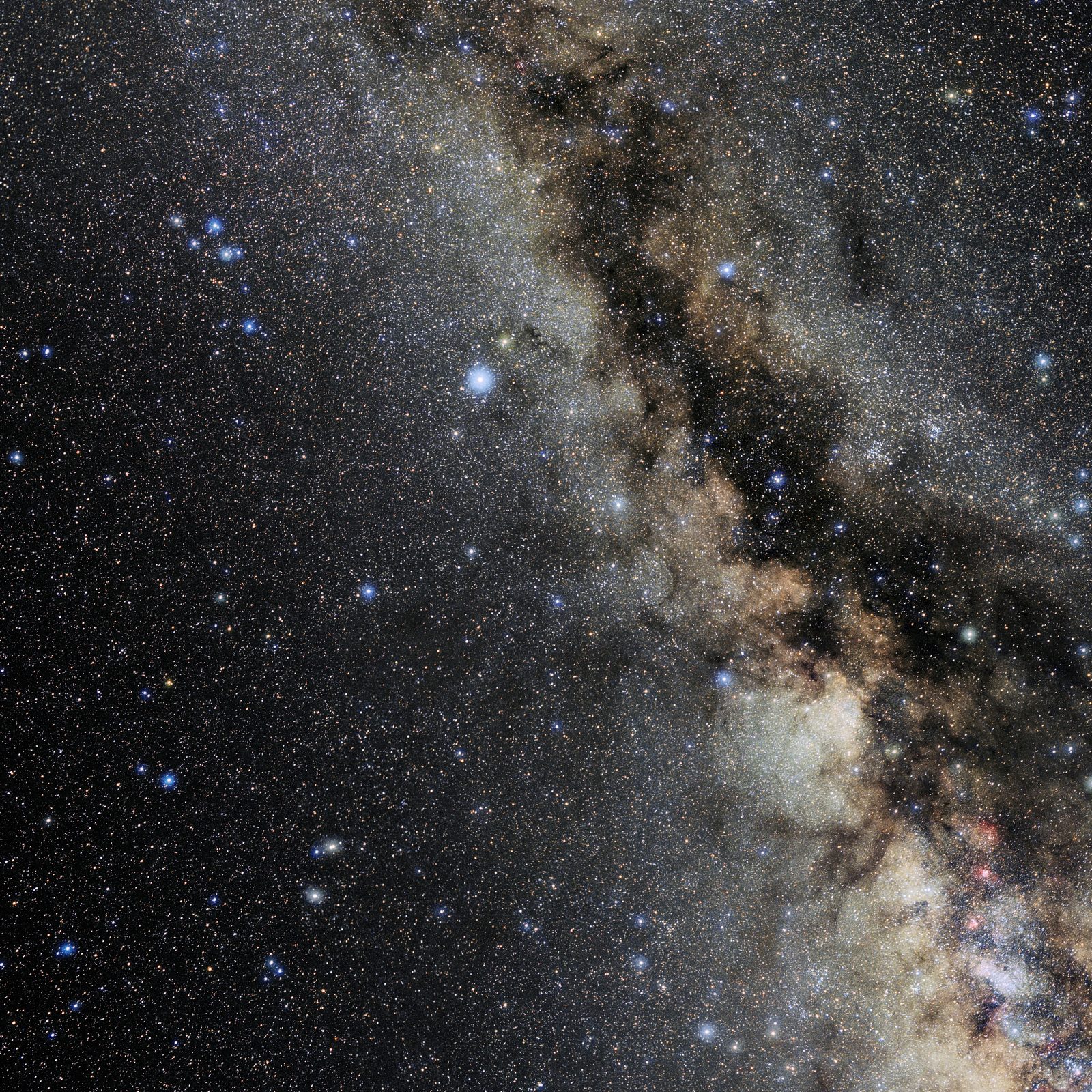
Having found it, look either side. A fainter star sits about 2 degrees away on the northern side, higher up: that is Tarazed, magnitude 2.72. Another sits about 2.7 degrees on the southern side and lower: Alshain, magnitude 3.71. The three stand in a line a shade under 5 degrees long, with much the brightest of them in the middle. That is the whole station.
The same figure, and not the same at all
Three in a row, the bright one in the middle: that is exactly the shape the eighteenth station, Jyeshtha, makes, and it would be dishonest of me not to say so out loud. But hold the two side by side and almost nothing survives the comparison. There the middle star is orange and enormous and 550 light years off. Here it is white, ordinary in size, and sixteen and a bit.
The bigger difference is kinship. The four stars of the seventeenth station came out of one cloud of gas and are still travelling together, which is rare. These three are strangers. Alshain is about 44 light years away, nearly three times as far as Altair. Tarazed is about 395 light years away, nearly 24 times as far, an orange bright giant that only looks modest because of the distance. Move a little way off in any direction and the line stops being a line. It is an arrangement of our address, not of theirs.
The middle one repays attention on its own. Altair turns on its axis in under nine hours, where the sun takes about 25 days, and its equator is moving at something over 240 kilometres a second. Spin like that has a consequence you can state as a measurement: the star is not round. It is about 2.03 times the sun's radius across the equator and about 1.63 from pole to pole, a quarter wider one way than the other.
That is not an inference from theory. In 2007, in Science, a group led by John Monnier published a picture of it, made by combining the light of several telescopes on Mount Wilson working as one instrument. The disc in the image is visibly squashed, and the equator is dimmer and cooler than the poles, which is what happens when a star is flung outward at its own middle. It was the first time anyone had imaged the surface of an ordinary star other than the sun.
Altair is worn down from al-nasr al-ṭā'ir, the flying eagle, and the constellation is the Eagle in Greek and Latin as well. The two flanking stars carry a different picture entirely: Tarazed and Alshain both come out of a Persian phrase about the beam of a balance, which is what the three looked like to somebody else. One line of stars, a bird and a weighing instrument, and neither reading has anything to do with ours.
One more fact, and it is a negative one. Altair sits about 29 degrees north of the ecliptic, the line the sun keeps to, and the moon strays only some 5 degrees either side of that. So the moon never covers this star, has never covered it, and will not. Swati worked through what that does and does not mean, at length, and I am not running it twice.
Three steps
śravaṇa (श्रवण) comes off the root śru (श्रु), to hear. The dictionaries give the ear first, then the act of hearing, then learning by hearing, which is how most of this subject was carried for most of its life. The same entry describes the station in one flat line: three stars, Viṣṇu (विष्णु) presiding, the three said to represent three footsteps.
So the station keeps two symbols and they do not obviously match. An ear, and a set of footprints. The prints belong to the presiding figure, and the old story goes like this.
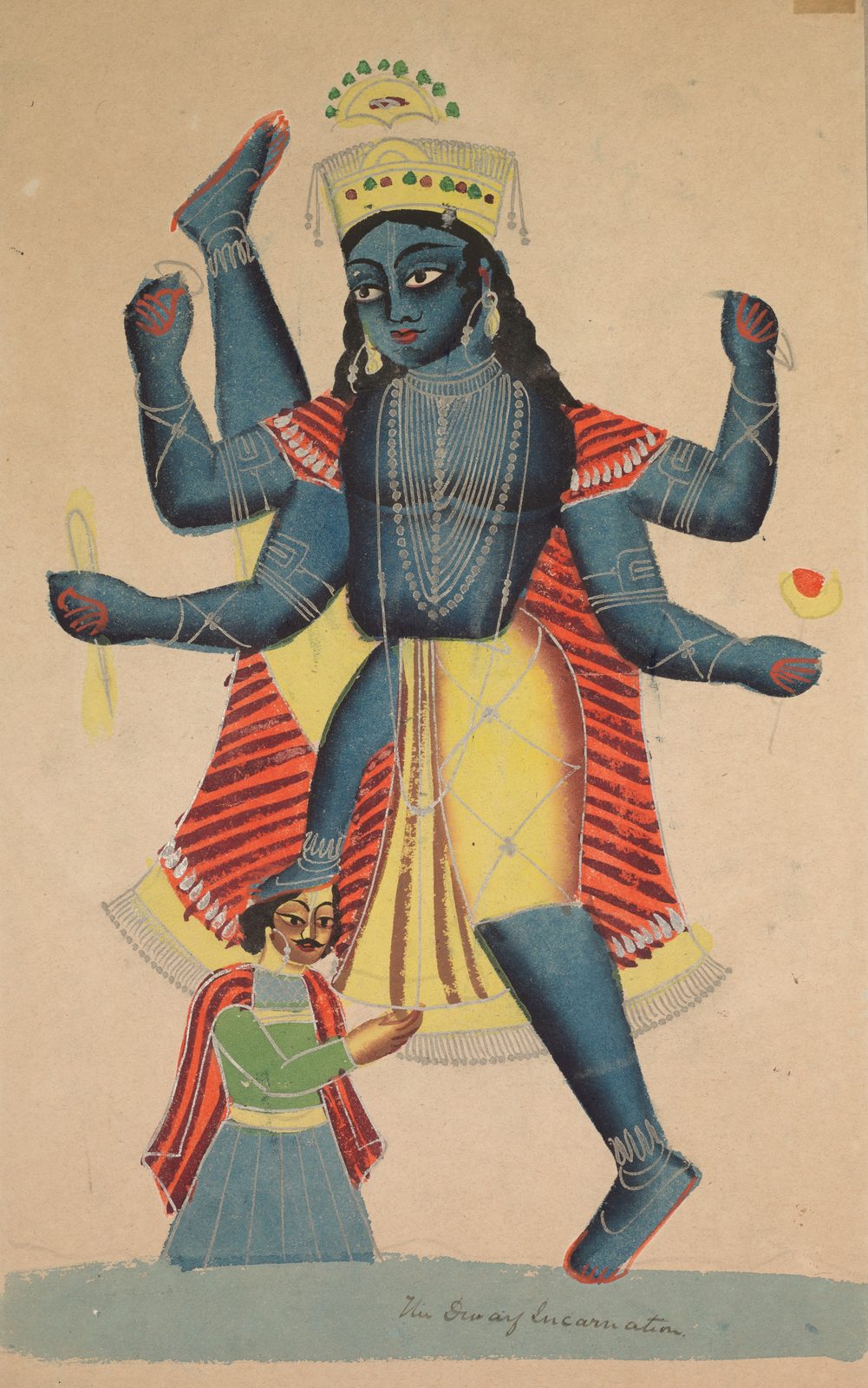
A king named Bali had won the three worlds and was holding a great sacrifice, at which he had undertaken to give whatever anybody asked. Vishnu came to him as a dwarf, Vamana, and asked for as much ground as he could cover in three steps. Bali looked at the small man and agreed, and poured the water that seals a gift. Then the dwarf grew. One step covered the earth and the second the sky, and for the third there was nowhere left, so Bali offered his own head and took the foot on it, and went below. The painting at the top of this file is that second step: a leg raised past its own shoulder, the little king still pouring.
The Rigveda has none of the story. What it has, in the hundred and fifty-fourth hymn of the first book, is the striding itself, and I am paraphrasing rather than quoting: the god measures out the earthly spaces in three paces, and the highest of the three is somewhere nobody follows him to. The dwarf and the king arrive later, in the Brahmanas and then in the Puranas, and how a hymn becomes a story is a subject with its own writers on this blog. The month of Shravan takes its name from this station, as the other eleven months take theirs from stars, which is the almanac's subject and not mine.
Put the story down now. The name is the useful part, and it names a sense rather than a picture.
Here is what I would actually do with it, and it is field practice rather than anything more solemn than that. Go up, find the three, hold them long enough to be sure of the order. Then stop looking. Stand still where you are, give the night one full minute by a clock, and catalogue what your house sounds like from the roof. A generator two streets over. A tap somebody left running. Bats, which are audible more often than people think. The particular noise of your own building settling after the heat.
Hearing is the observer's second instrument and nobody writes it into the observing notes. It works in the dark, which is when we work. It works behind you. It does not need to face its object, and it will not turn off, which is why we stop noticing it: the ear has no lid. An hour on a terrace is an hour of information you took in and did not record.
The handbooks turn Shravana into a paragraph about listeners: students, retainers of what they are told, people who learn by being spoken to. Wear that loosely, as always, and take the questions instead of the verdict. Who do I actually hear, as against merely register. When did I last let somebody finish without assembling my reply while they were still talking. Those are answerable this week, which is more than can be said for most of what gets attached to a birth star.
So: an evening in the second half of October, around eight, most of the way up the sky and a little west of south. The brightest thing there, a fainter star above it, a fainter one below. Hold the three for a moment.
Then stop looking, and give the night one minute. Go down when you can name five sounds you had not noticed you were hearing.
Twice a week
Essays like this one, Tuesdays and Saturdays. One email per essay, and the archive is never mailed out. Subscriptions open shortly; the RSS feed is live now.
Nothing else arrives, ever.