Nakshatra files · Yamini Sardesai
Pushya: the nourisher
Two stars in Cancer are called the donkeys, and the grey patch they feed from is a thousand suns. A visit to the station the tradition calls kindest.
Two ways in. The gist assumes you have never met any of this before.
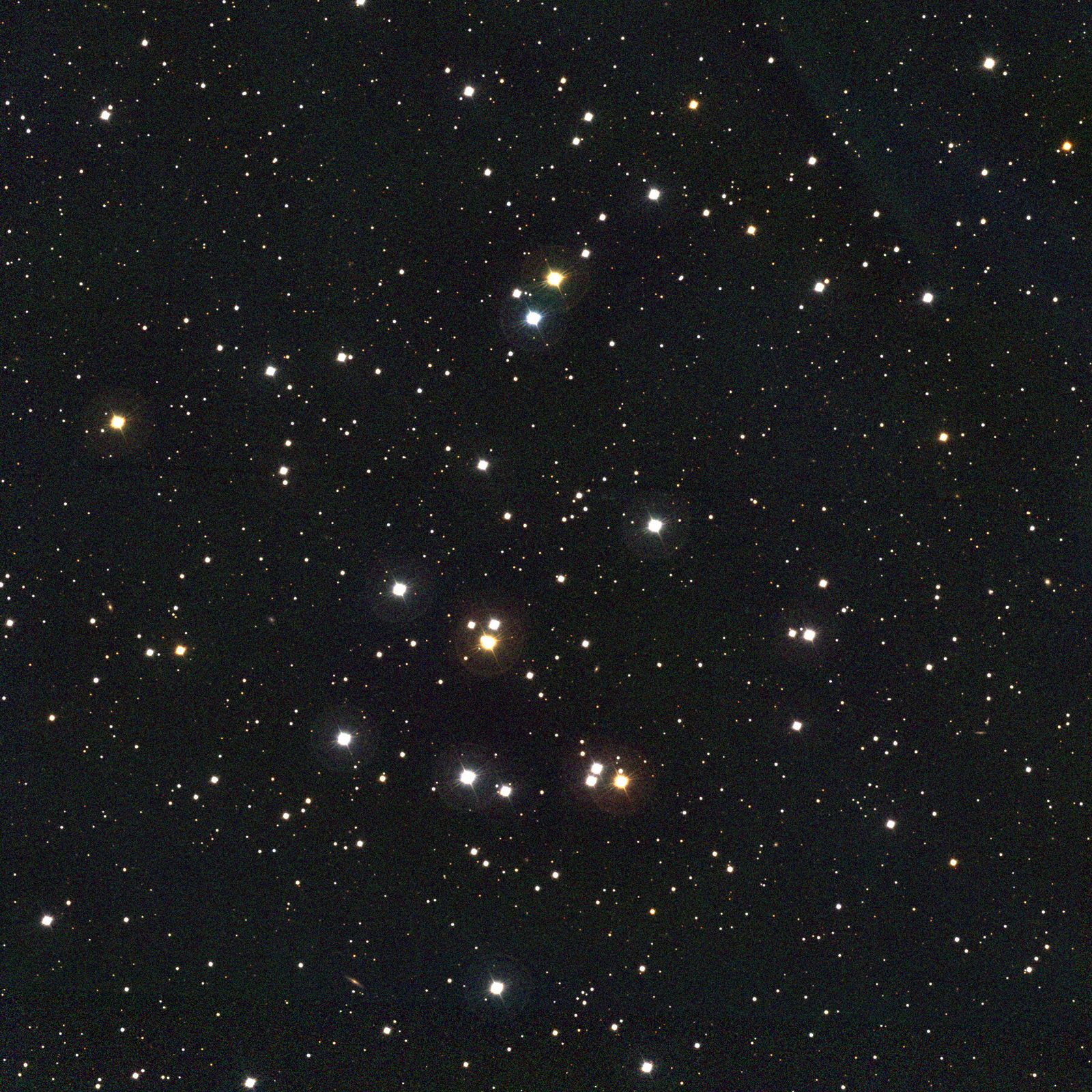
Puṣya (पुष्य), the eighth of the 27 lodgings the moon works through on its circuit of the sky, is a faint grey patch in a dim constellation, and the name means the nourisher. Somebody in Greece looked at the same patch and called it the manger instead. Neither had any way of telling the other, and no third party told them both.
The Greek and Latin end of it is properly furnished. Two stars stand on either side of the patch and they are called the donkeys: Asellus Borealis and Asellus Australis, the northern and the southern ass colt. They are eating. What they are eating from lies between them and a little below, and Latin calls it Praesepe, the manger. It is not a star. On a genuinely dark night it is a small grey smudge about three full moons wide, and it stays a smudge however long you look at it.
The name comes from the root puṣ, to nourish, to make a thing thrive. The handbooks translate it as the nourisher and draw a cow's udder beside it.
Underneath both pictures there are only three stars, and the plain names are worth having. They are gamma, delta and theta Cancri, at magnitudes 4.67, 3.94 and 5.32. Magnitude counts brightness downwards, so the larger number is the fainter star, and about 6 is the limit of a good eye in a dark place. Two of those three are the donkeys. Cancer is the faintest constellation in the zodiac. Only two of its stars are brighter than the fourth magnitude, and none of them is bright enough to find your way by.
Getting there
Begin with the fortnight that is shut. At the turn of July into August the sun stands in this part of the sky, and in the first two days of August it passes over Asellus Australis, near enough exactly. That star sits 8 hundredths of a degree from the ecliptic, which is the line the sun walks against the stars. Anything that close to the line disappears into the glare once a year and takes several weeks over it.
The door opens again in the second half of September, in the last dark hour before dawn, with the manger about 25 degrees up in the east. By the end of December it is rising before eight in the evening. By late February it stands almost overhead at ten at night, which is the sitting to plan for if you would rather not lose a night's sleep to it. Those clock times are Delhi's and slide by a few minutes across the country. Unlike the moon, they come back the same way every year.
When you go, do not look for the crab. Two bright stars will do the work instead: Pollux, the nearer twin of Gemini, and Regulus at the foot of the Lion. Draw the line between them, and the manger sits a little short of halfway along it, on the Pollux side. Pick the week around a new moon, give your eyes 20 minutes without a screen, and look slightly off to one side of the place, the way you learn to with faint things.
What arrives is a cloud. The cluster as a whole is magnitude 3.7, which sounds generous until you remember that the light is spread across a degree and a half of sky rather than gathered into a point. Put binoculars on it and the cloud comes apart into stars. Galileo did that in 1609, with the first instrument anyone had pointed at it, and counted 40. The brightest single member is magnitude 6.29. Not one guest in that house is a naked-eye star on its own account. You see the house only because there are about 1,000 of them, held together by their own gravity, roughly 600 light years off. The published distances run from about 520 to 610, so hold the figure loosely.
The age is where it gets companionable. The cluster is somewhere between 600 and 700 million years old, which is also the age of the Hyades, the lopsided V of faint stars behind Aldebaran. The two groups are moving through the galaxy in the same direction at the same speed. The likeliest reading is that they came out of one cloud and have been drifting apart ever since. Two houses, one family, a long way apart now, and both of them still recognisable as crowds.
Because it is a cloud and not a point, the manger is the first thing in that quarter of the sky to go. Thin high haze that leaves the bright stars untouched will wipe a diffuse patch out completely. The Greeks noticed. Aratus, writing in the third century before our era, tells his reader to watch the manger: if it goes dark while the stars around it hold steady, expect rain. Pliny repeats the rule three centuries and more later, and says a manger invisible in a clear sky means a violent storm. Whether it forecasts anything I would not swear to. The vanishing is real, and you can test that part yourself in one bad hour.
Our own catalogues describe the look of this station with the word meghavat (मेघवत्), cloudy, from megha, cloud. So the Indian record was not really describing three stars either. It was describing the smudge between them.
The moon comes here too, and closely. Delta Cancri sits so near the ecliptic that the moon occults it outright: covers it, holds it out of sight for a while, hands it back. Some months the moon passes over the cluster itself, some months above or below, depending on where its tilted path has reached. Once a month, for about a day, the almanac column for that day's nakshatra reads Pushya, and the moon is standing in the manger while it says so.
The host
The presiding figure of this station is bṛhaspati (बृहस्पति). In the Rigveda he is not a king but a priest: born of the first light, the one who pushed the darkness back, the lord of sacred speech, the household priest of the gods. His bowstring, in one description, is ṛta (ऋत), the order things are meant to keep. Later the same name is given to the planet Jupiter and to Thursday, which is guruvāra, the teacher's day. It is the older figure I would keep hold of here. He does not own the house. He is the one who speaks properly on behalf of everybody in it.
Where Thursday falls on Pushya, the almanacs mark the pair as guru-puṣya, and the market sells against the date: special pujas, gold offers, a price set for the occasion. I am not spending a paragraph on it.
This is the station everyone calls the kindest, and the names agree. An older name for it is tiṣya (तिष्य), which means auspicious, fortunate; Amarasimha's dictionary calls it sidhya, prosperous; the muhurta handbooks, the ones that pick times for doing things, recommend Pushya for very nearly anything a person might begin. And then they make an exception, and the exception is marriage. The explanations offered for that are not ones I find convincing. I bring it up because a station advertised as good for everything turns out on inspection to be good for a list with a hole in it, which is what most traditions look like from close up.
The word auspicious is also doing less work than people assume. In this material it labels a time somebody chose for beginning a thing. It is not a statement about how the thing ends. And the lord assigned to Pushya in the period system is not Brihaspati at all but Shani, Saturn, which the same handbooks carry alongside the kindness without any sign of discomfort. If the gentlest station answers to the strictest planet, then whatever kindness means here, it does not mean softness.
I am not going to write the paragraph about how Pushya people are nurturing and wonderful with children. That paragraph exists in bulk and it costs nothing to produce. What the station offers, if you want to use it, is a subject, and the subject is feeding. Who fed you, what it cost them, and whether anybody ever told you. What you feed now, and whether you can actually afford it. Whether the people you look after have any real way of refusing what you hand them.
That last one is the hard one, and the manger is honest about it in a way the handbooks are not. A manger is where you feed animals you intend to keep. Care and ownership use the same hands and very often the same money, and from inside a household the two are almost impossible to tell apart. Somebody who has spent 30 years feeding a family may be the most generous person in that house, or may be running it on a debt nobody is allowed to name aloud, and the plates look identical either way. No chart decides that. You can decide it slowly, by noticing what happens the next time somebody says no to you. That is a question worth carrying into a consultation, and whether the consultation is any use will depend on whether you leave it holding more of your own life or less.
You will not catch it arriving. Nothing in that stretch between Pollux and Regulus comes on the way a star comes on, with a point of light where a moment ago there was none, and no amount of staring at the spot will hurry it. Give it a morning in the second half of September, the hour before the sky greys, and keep your eye a little to one side so the thing can arrive at the edge of your looking. What comes up over the eastern rooftops is a piece of the night that is not quite as black as the rest, three moons wide, with a thousand guests inside and the door left open.
Twice a week
Essays like this one, Tuesdays and Saturdays. One email per essay, and the archive is never mailed out. Subscriptions open shortly; the RSS feed is live now.
Nothing else arrives, ever.