Nakshatra files · Yamini Sardesai
Punarvasu: the two who come back
Gemini spends part of every year behind the sun. Where those two stars go, what they actually are, and the mornings they come back to the east.
Two ways in. The gist assumes you have never met any of this before.
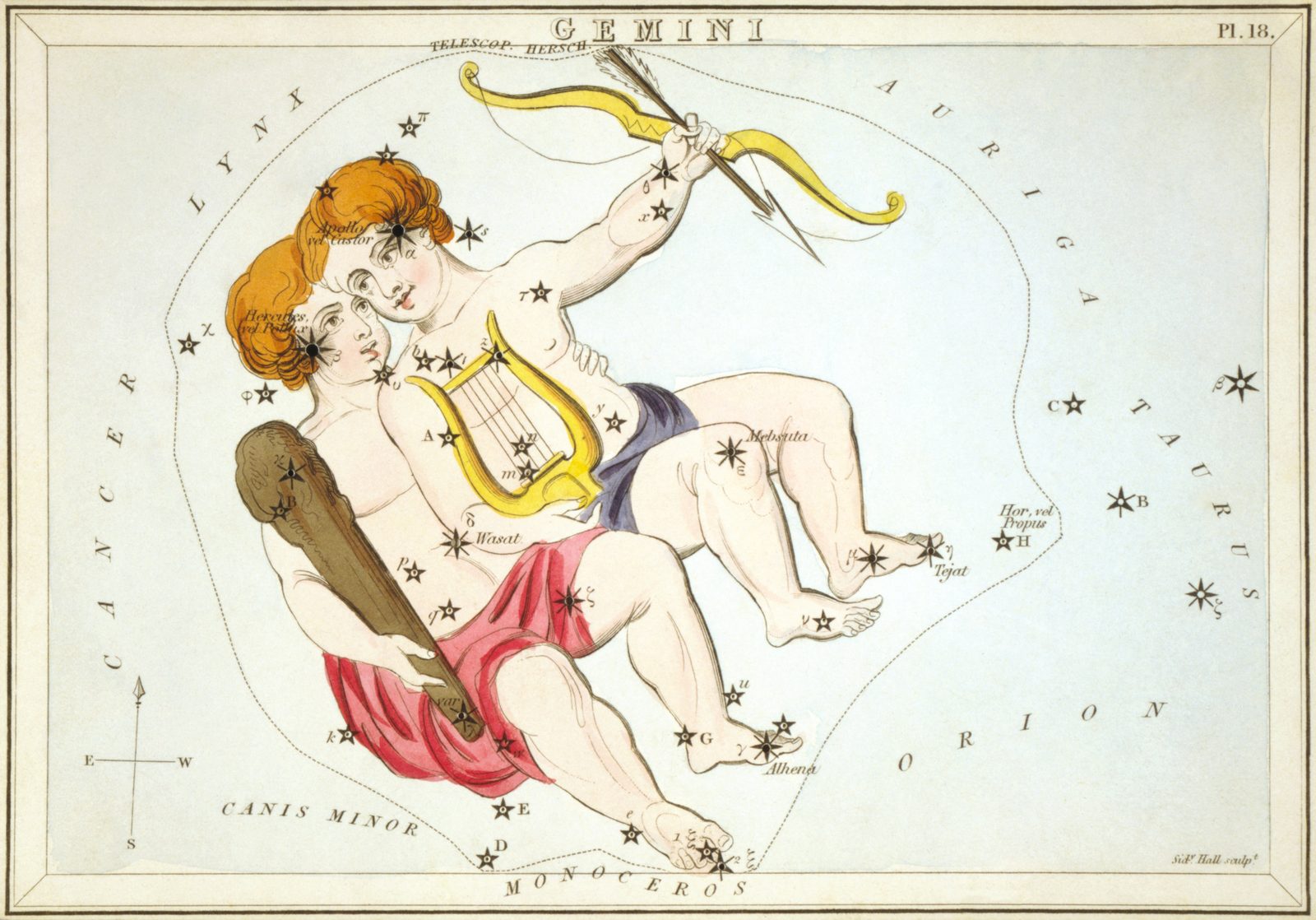
Punarvasu (पुनर्वसु), the seventh of the 27 stations, is shut for part of every year, and there is no way round it. Around the 21st of June the sun arrives in this patch of sky and stays until about the 20th of July, and for some weeks on either side of that there is nothing to go out for. The stars are still up there. They are over your roof at two in the afternoon, behind all that light, no use to anybody.
If you caught them leaving, it was on an evening in May: two points side by side, low in the west after sunset, sinking a little earlier each night. Then they went down into the glare and the year carried on without them.
So this file begins with an absence, which is awkward, and which is also the whole point. The 27 stations are the nakṣatra (नक्षत्र), one lodging for roughly each night the moon takes to get round the sky. This is the seventh of them, and its name is about coming back.
The two stars are Castor and Pollux, the bright pair at one end of the constellation the West calls Gemini. Take the brighter of them first, because it is the one people get wrong. Pollux is magnitude 1.14. Brightness here runs on a scale that goes the wrong way: the smaller the number, the brighter the star, and 1.14 makes Pollux the brightest star in Gemini. It is 34 light years off, which is near. It is an orange giant: a star that has used up the hydrogen in its core and swollen, about nine times the width of the sun, and around 4,800 degrees at the surface where the sun is nearer 5,800. That is cool, as stars go, and the coolness is the colour.
It is one star. Not a double, not a triple. But it does have a household. In 2006 a planet was confirmed in orbit around it, found by watching the star wobble: a planet tugs on the star it circles, and the tug shows up as a small regular shift in the star's light, out and back, out and back, on a fixed period. This one has at least twice the mass of Jupiter, and it goes round in about 590 days, a little over one and a half times as far out from Pollux as we are from the sun.
Then Castor, which is where the arithmetic gets out of hand. To your eye it is a single white star at magnitude 1.58, which makes Pollux about half again as bright. That is already odd. In 1603 Johann Bayer went through the constellations handing out Greek letters, brightest star first. He gave Castor the alpha and Pollux the beta. Castor is the fainter of the two.
Put a telescope on it and it becomes two, about 6 arcseconds apart at present, which is around a three-hundredth of the width of the moon. The gap is opening year by year as the two work round an orbit of some 460 years. Then the spectrographs got at it, and each of those two turned out to be two. And a faint red star that had long been known to be tagging along turned out to be two as well, a pair that eclipses itself.
So Castor is six stars in three pairs, and each pair keeps its own time. The faint red couple goes round in 19 and a half hours. One bright pair takes nine days. The other takes 93. The two bright pairs take four and a half centuries around each other. The red couple takes something like 14,000 years to get around all of them, which is to say it has not come round once since anybody started keeping a record of anything.
One point of light. Six stars inside it, none of them still, and every one of them on its way back to where it was.
The two are not even a pair. Pollux is at 34 light years and Castor at about 50. They are not bound to each other, they are not the same kind of star, they are not the same age. They stand together because of where we happen to be sitting.
Now the name, which is the hinge of this file. पुनर्वसु, punarvasu, and the older form of it is a dual: punarvasū, the two of them. Punar is again, back, once more. Vasu is goods, wealth, the good things a household keeps, and it also carries the sense of dwelling. The standard Sanskrit-to-English dictionary, the one compiled by Monier-Williams, translates the whole word as restoring goods. The two who bring the good things back, then. The two that come again.
The same dictionary entry calls this the fifth or the seventh lunar mansion, and both are correct, because the list of the 27 once began at Krittika and now begins at Ashwini. The station kept its place in the sky while its number changed underneath it.
The handbooks draw a quiver beside this station. Not a bow, not an arrow: the container. A quiver is the thing you draw down and fill again.
The presiding figure is Aditi (अदिति), and her name is a negative. A-diti: not tied, not bound. The dictionary gives boundlessness, freedom, safety. She is the mother of the Adityas, and in the Rigveda she is asked for protection, for blessing on children and cattle, for forgiveness. Read that list again. Those are not new things people wanted. They are things people wanted kept, or wanted back. Valmiki's first book puts Rama's birth on the ninth day of Chaitra with the moon standing here and Aditi presiding, which is the day now kept as Rama Navami.
There is an echo here I should name and then walk away from. The Greeks made these two brothers, and scholars of the old Indo-European material have long set their Dioscuri beside our Ashvins as two versions of one very ancient pair of divine twins. But our own list did not put its horse twins in this constellation. It put them right at the other end of the circle, in the head of the Ram, and gave this station a name with no brothers in it at all. Two traditions looked at the same two lights. One saw siblings. The other saw something returning.
The temperament the tradition hangs here usually gets translated as resilience, a word that offices have worn smooth and that could do with a rest. I would put it another way, and this is opinion and not doctrine. A reading built on this station is not about beginning. It is about the second attempt: the thing you put down and could pick up, the person you stopped ringing, the work you left at 80 per cent and have not opened since. Nothing in Gemini or anywhere else knows whether any of that comes back. But the questions have a person in them, which is the only kind worth asking. What am I trying to restore rather than start. Is this a return, or only a repetition. What would I have to be willing to find changed.
And now the way back, which is the part you can use.
From about the middle of August, Pollux clears the eastern horizon a little before 3:30 in the morning, roughly two and a half hours ahead of the sun, and by the time the sky starts to grey it stands a good way up. Each night it rises four minutes earlier than the night before. Four minutes is nothing and it adds up to two hours a month. By the start of September it is up a little after two and better than 30 degrees high at five. By the middle of October it is up before midnight. By the first week of December it is rising around eight in the evening, and you are no longer setting an alarm for it at all.
Everything in this series so far has sent you to a low eastern horizon, to squint over a water tank at something faint. Not this one. From Delhi, Pollux passes within about half a degree of straight overhead, a little more than the moon's own width from the exact top of the sky. Further south it misses by more: 15 degrees from Chennai, which is still very high. But across the north this is the station you lie down for. Take a mat up with you. Your neck will thank you, and your eyes work better once the rest of you has stopped.
When you have them, look at the colours and do not let anyone tell you the two are alike. Castor is white, flat and clean. Pollux is warm, though nothing like Rohini, which is cooler at the surface and far redder for it. Call this one a mild yellow, nearer brass than fire. The colour belongs to the star, not to your air. Anything low down reddens, which is why the sun goes orange as it sets, but by the time you are lying under these two they will be nowhere near the horizon and there is nothing left to blame.
Then wait, if you like, and it gets easier still. By the middle of February the same two stand overhead at 10:30 at night, over a dry terrace, at an hour when people are still awake. You will not have done anything to bring them there.
Twice a week
Essays like this one, Tuesdays and Saturdays. One email per essay, and the archive is never mailed out. Subscriptions open shortly; the RSS feed is live now.
Nothing else arrives, ever.