Nakshatra files · Yamini Sardesai
Krittika: the blade and the flame
Count the Pleiades before dawn and see how many you get. Then the six who nursed a god, the seventh who stayed, and what a sharp edge is actually for.
Two ways in. The gist assumes you have never met any of this before.
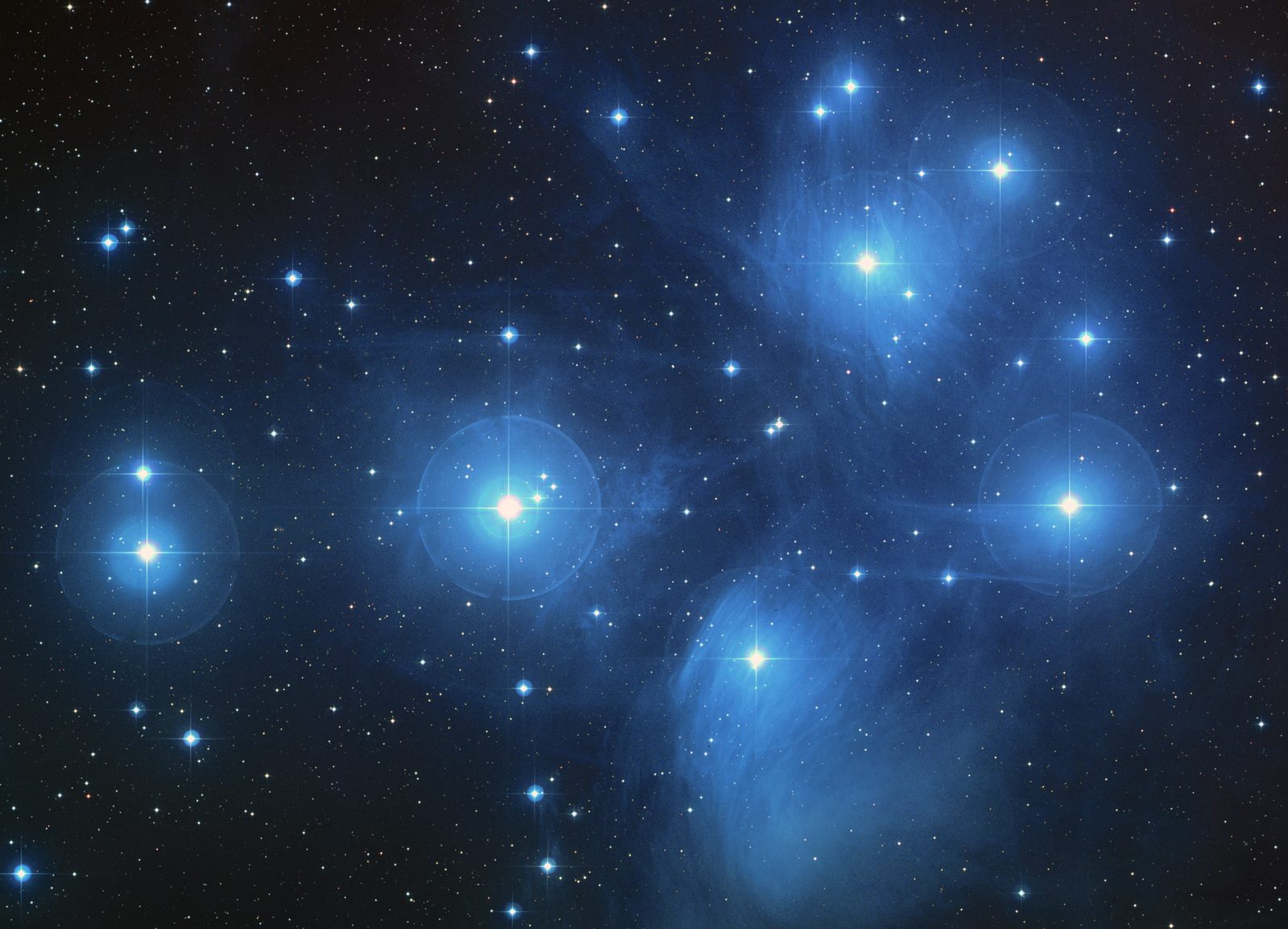
Kṛttikā (कृत्तिका) is the Pleiades, and the assignment for this file is to count it: go out, get a number of your own, and hold on to it before you read further, because once you know what the answer is supposed to be you will start seeing it.
The complication is which morning. Not this one. In July the Krittikas are at the wrong end of the night: from Delhi the cluster comes up at 1:50 in the morning and is gone by 4:45, having got no higher than 35 degrees. In October you get it after dinner. In July you get up for it. And this morning there was a moon in it: a 14 per cent waning crescent that rose with the cluster and sat 5 degrees off, with Mars along the same line and Aldebaran beyond. A fine sight. A hopeless sky for counting faint stars.
So take the next one. The moon is new on the 14th; from about the 16th to the 21st it is a waxing crescent down before midnight, the cluster is up by 1:30, and it stands better than 40 degrees before dawn. Pick a morning in there and set an alarm for two.
Face east, a little towards the north. Wait for a small blurred knot of light to come up over whatever your horizon is: rooftops, a water tank, a neem tree. It is not a star. It is a crowd. It will look at first like a smudge, then like a very small cart or dipper, and then, once your eyes have given up on your phone and settled into the dark, it resolves into separate points. Count them. Write the number down. Take the 20 minutes first. Nobody counts properly in the first two.
It is the easiest star cluster in the sky to find and the one almost everybody has already seen without knowing they were seeing anything in particular. It sits about 440 light years away, far enough that the light landing on your eye set out in the reign of Akbar. It is a genuine family: stars born together out of the same cloud a little over 100 million years ago, still travelling as a group, not yet pulled apart by the drag of the galaxy. The brightest of them, Alcyone, is magnitude 2.9, and the whole group spans about 2 degrees, which is to say you could line up four full moons across it.
That is the thing itself. Now the counting.
Six, or seven
Most people get six. Under a dark rural sky with good eyes, seven. Beyond that it is a matter of transparency and youth and stubbornness; observers have claimed a dozen, a few have claimed 20, and I have never met anyone honest who got past nine.
The interesting part is that this argument is neither new nor local. There is a story about a missing sister almost everywhere the cluster is visible. Robert Burnham Jr., who spent a working life compiling what people have said about the sky, found the lost-Pleiad tale in European, African, Asian, Indonesian, Native American and Aboriginal Australian lore: a group named as seven, seen as six, with a local reason for the absence. In the Greek version one sister loved a mortal and dimmed with shame; in several Australian traditions one is hidden, or too young, or taken.
There may even be a physical culprit. The seventh-brightest member of the cluster is Pleione, a shell star: it spins so fast that it periodically throws off a ring of gas, and its brightness shifts while that ring forms and disperses. A star that dims and returns over decades is exactly what a sky-watching culture would notice and then explain with a story about a sister. The tale is older and wider than any one star's temper, so I will not claim this is the origin of every version. But it is a pleasing thought that the missing sister may have been genuinely missing, on and off, for a very long time.
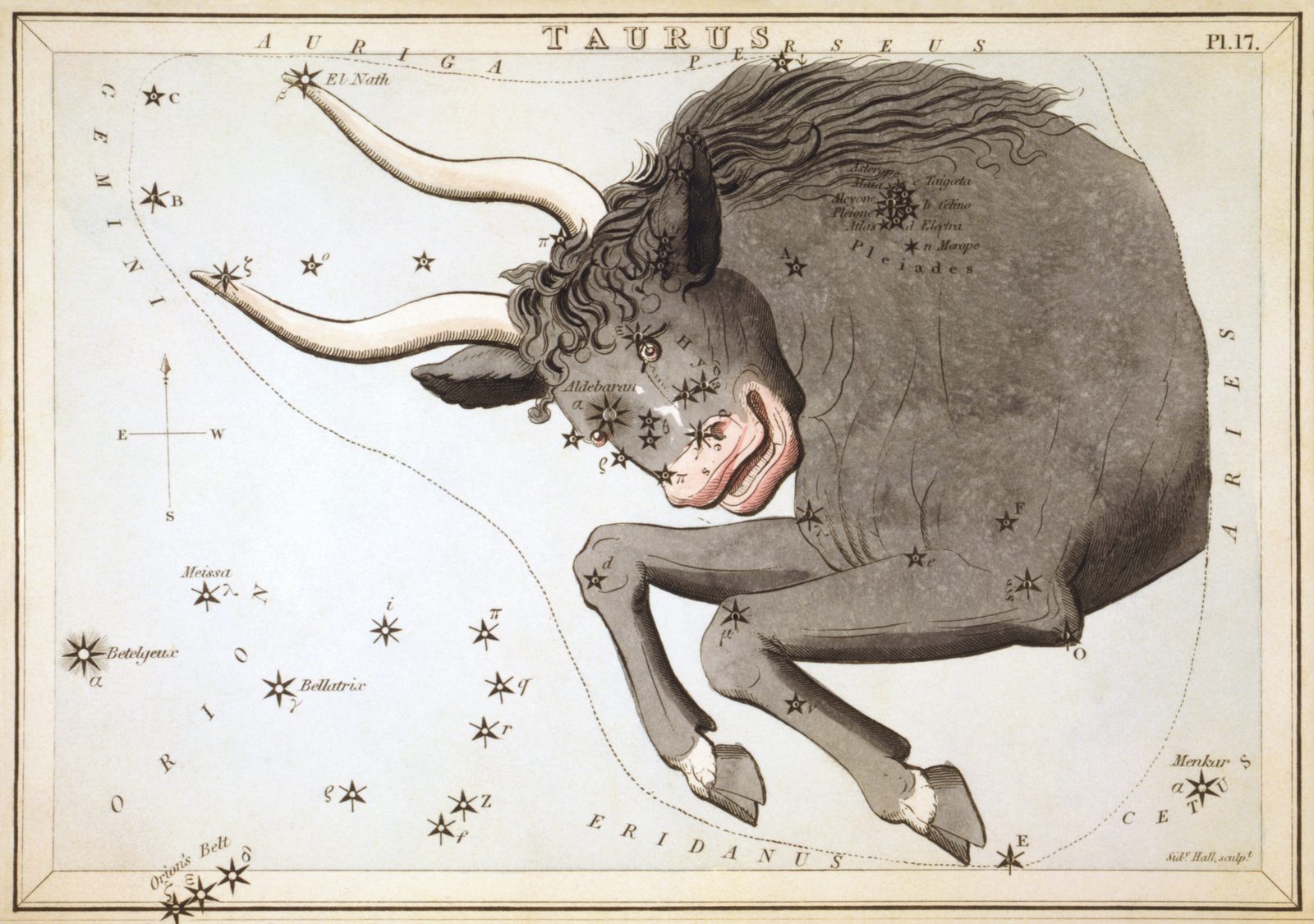
Ours is one of the good ones. In our telling the seven were the wives of the seven sages, the Saptarishi, and six of them were accused of having loved Agni. And the six left, or were sent away, and became this cluster. One stayed: Arundhati, the wife of Vasishtha.
Here is what makes that story worth telling rather than repeating. She is still up there. Arundhati is the star western catalogues call Alcor, the small companion tucked against Mizar in the handle of the Saptarishi, 12 arcminutes away from it (not much more than a third of a moon's width). Mizar is magnitude 2.2 and Alcor is 4.0, and separating them by eye has been used as a vision test for at least 800 years; a thirteenth-century Persian writer already noted people testing their eyesight by it. In this country the same pair is shown to a newly married couple after the fire ceremony: come outside, look up, find the small one beside the bright one.
Which means two eyesight tests at opposite ends of the same story and, this month, at opposite ends of the night. The Saptarishi is an evening object now: from Delhi, Mizar stands better than 50 degrees up in the north-west as dusk finishes, sinks all evening, and sets around four in the morning, about when the Krittikas are getting good. So do Arundhati before you sleep, while the pair is high enough to be fair to your eyes, and leave the counting for the alarm. (The further south you live, the earlier it goes.) Do both in one night and the story stops being decoration.
The six have another job in the old material. When Kartikeya was born it was they who nursed him, and he is said to have grown six faces so as to drink from all of them at once. That is where Shanmukha, the six-faced, comes from. He carries their name rather than either parent's, which tells you something about who did the work.
What a blade is for
The name is usually taken from the root kṛt, to cut, and the handbooks draw a razor beside this one. The presiding figure is Agni (अग्नि), fire. Blade and flame, in the same station.
You can see how a certain kind of astrologer gets from there to harsh, critical, destructive, and then to a paragraph about your temper that makes you feel watched. I want to argue with the reasoning rather than the tradition, because I do not think the tradition says it.
Consider what a cut actually does. Nothing on your plate tonight arrived there uncut. Rice was threshed, the onion was halved, the fish was opened, the coriander was chopped so it would give up its smell. Between the field and the meal stand exactly two instruments, the knife and the cook-fire, and both of them are Krittika. Cutting is how raw material becomes food: the first move in feeding somebody, which is what the six do in the story of Kartikeya.
Or take the surgeon. The incision is the treatment, and the whole skill is knowing where, how deep, and when to stop. Anyone can make a wound. Making the one useful wound is a lifetime's training, and the reason we let strangers do it to us is that they have spent it learning where not to go.
And then there is the cut paragraph. The one taken out is usually the one that was making the others unreadable. Nobody notices the sentences that are gone; they notice that the thing now moves. Anyone who has written anything knows the misery of being right about a passage and having to lose it anyway, and the moment afterwards when the piece stands up on its own.
Sharpness is not cruelty. It is the opposite of vagueness. And the dangerous knife in any kitchen is the blunt one: it slips, it tears, it needs force, it does the damage that a sharp one never does. If Krittika carries a warning, it runs something like this: an edge is only safe in the hands of somebody who has decided what they are cutting and why. Which is advice about attention, not about fate.
Where the year used to begin
One more thing, and it is my favourite fact about this cluster.
Krittika is the third nakshatra now, and Ashwini is the first. It was not always so. In the oldest lists we have (in the Atharvaveda, in the Taittiriya Samhita), the count begins here, with Krittika. The usual explanation is that the equinox stood at or near this cluster when those lists were fixed, so this was where the year turned, and a list of the moon's lodgings sensibly began where the sun crossed. That is an inference rather than a statement any of those texts makes, and I think it is a good one.
The equinox has since moved. It slides backwards through the stars at roughly a degree every 72 years, and in the millennia since it has walked out of Krittika, through Bharani and Ashwini, and on into the stars of the Fish. That drift is the slow clock under every chart ever cast, and it is the reason the tradition's own first station changed while nobody was watching. The list was reordered. The cluster did not move.
A trace of the cluster's old standing survives in something you use every year. The lunar month Kartika is named for these stars, because its full moon falls at or near them: the same rule that gives us Chaitra from Chitra and Vaishakha from Vishakha. Which nakshatra the moon is standing in on a given night is one of the five things an almanac reports about a day, and once a month, for about a day, the answer is this crowd of blue stars.
So. The number is still owed. Get it on a morning after the 14th, and then tell me honestly whether knowing what you were looking for made you careful or made you generous.
Twice a week
Essays like this one, Tuesdays and Saturdays. One email per essay, and the archive is never mailed out. Subscriptions open shortly; the RSS feed is live now.
Nothing else arrives, ever.