Rudraksha, from tree to invoice
The bead is a fruit stone and its faces are seed chambers. What the old chapter grades, where the planetary price list came from, and who gets paid.
Two ways in. The gist assumes you have never met any of this before.
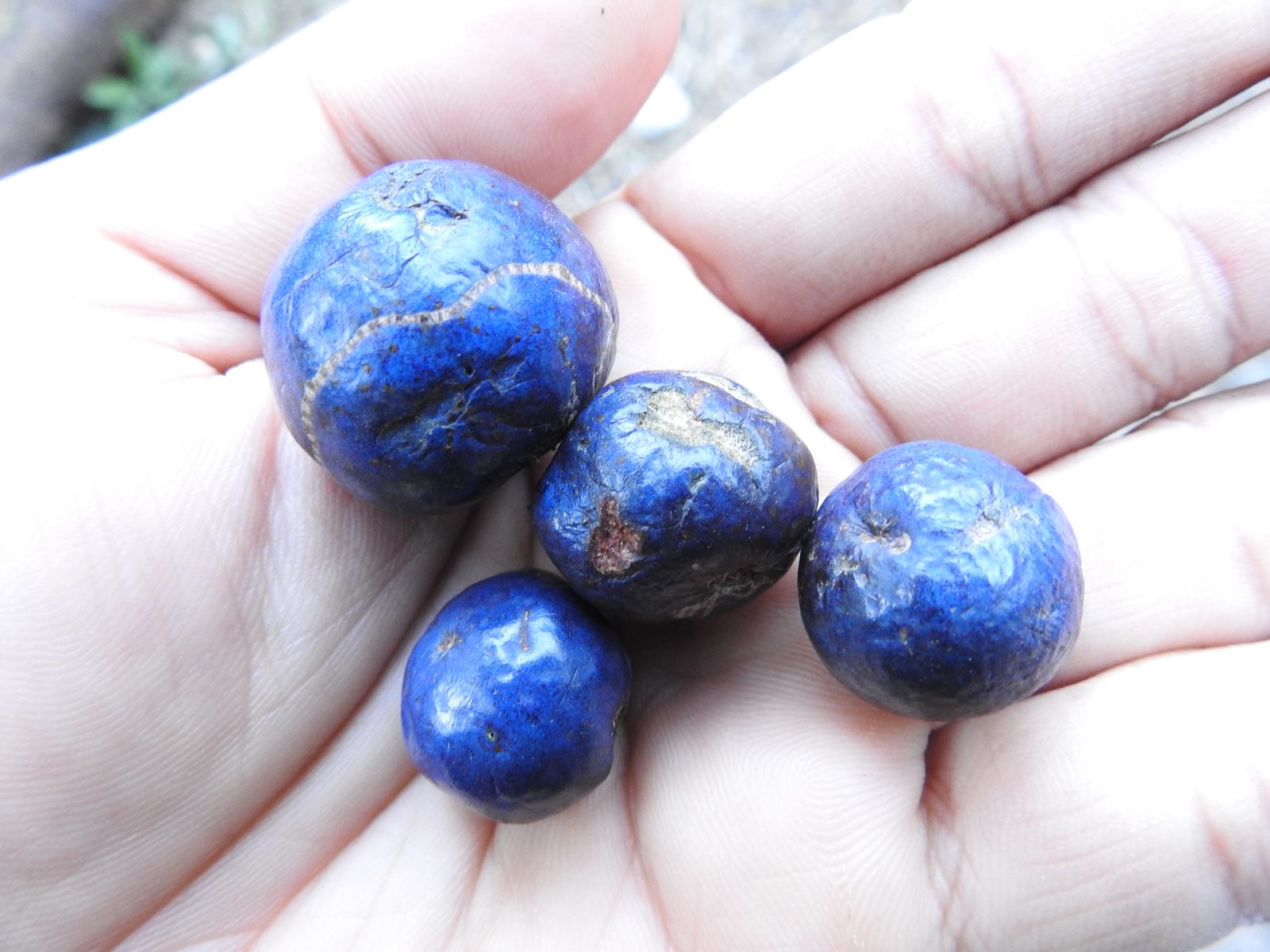
Rudrākṣa (रुद्राक्ष) beads are priced by a count of ridges, and the price climbs as the count moves away from what the tree usually makes. Five ridges is ordinary, and nobody disputes it: the five-faced bead is sold by the kilogram where it grows. The round one-faced bead is rare enough that what is generally sold under that name comes off a different tree. That ladder is the retail argument entire, and not one rung of it is a statement about the sky.
The thing being graded is a fruit stone. The tree is a tall evergreen. The trade calls it Elaeocarpus ganitrus; Kew's Plants of the World Online treats that name as a synonym of Elaeocarpus angustifolius and gives the species a range running from the Himalaya to Yunnan and out into the southwest Pacific. Its fruit is a drupe, meaning flesh around a single hard stone, the way a mango is, and it ripens to a deep dusty blue about the size of a large marble. Strip the flesh, dry what is under it, and you have the bead. That is the whole manufacture, and it is done in a yard.
The stone is brown, hard, and ridged from end to end. Those ridges are the mukhī (मुखी), the faces. Each marks off a locule, a chamber in the stone, and a chamber usually holds a seed, though not every one is filled. Count the ridges outside and you have counted the chambers inside.
None of that is contested. A devotee and a botanist could walk through it without a raised voice. The disagreement starts where the price does.
What the chapter grades
The text people cite is the Śiva Purāṇa (शिव पुराण): the twenty-fifth chapter of its Vidyeśvara-saṁhitā, 95 verses on the greatness of the bead. Shiva tells Parvati that the beads came from drops that fell from his eyes. Then the chapter does something that surprises anyone who knows the subject from a shop counter. It grades.
It grades by size, inside two verses: a bead the size of an amla is the most excellent, one the size of a jujube middling, the meanest the size of a gram. It lists six kinds to discard: worm-eaten, cut, broken, cracked, not round, and one lacking the small thorn-like protrusions. It ranks a bead with a natural hole from end to end above one bored through by hand. And in the standard English rendering, one verse holds that the lighter the bead, the more fruitful it is.
Size, wholeness, a natural bore, lightness. Not one is an axis anybody sells on.
Then the chapter runs through the faces, and every assignment it makes is to a deity. One face is Shiva himself, four Brahma, five Rudra, six Kartikeya, ten Janardana, fourteen the highest Shiva. There it stops. The eleventh book of the Devī Bhāgavata (देवी भागवत) covers the same ground and stops in the same place. The nearest thing to a graha (ग्रह) in either is a line saying the ten-faced bead settles troubles caused by planets among other kinds of trouble, which is not a bead-per-planet table and does not become one when quoted with a chart open.
Two things follow, neither a criticism of anybody's devotion. The classification runs to fourteen while the shelf in front of you runs to twenty-one and past it. And the chapter goes out of its way to widen the door: people of all varnas and all stages of life may wear the bead, women and shudras named in the verse. Whatever that literature is doing, it is not restricting supply. Restricting supply is what a price does.
Where the planets came in
So where did the other table come from, the one that pairs a face count with a planet and hands you a purchase order?
Not from the classical jyotiṣa (ज्योतिष) handbooks, as far as I can check. Parashara's Hora Shastra gives its last stretch of chapters to remedial measures, specific about materials: recitation, fasts, gifts, offerings into fire, feeding, images of the planetary deities. I have gone through a standard English edition looking for this bead and have not found it. If it sits in a recension I have not seen, I would like the reference.
The market is franker than you would expect. Rudra Centre, a large online seller, states on its own pages that scripture gives the ruling deities of the beads, and that the planetary, rashi and nakshatra associations arrived much later, in the 1970s. I cannot check the decade. A seller has no reason to date their own product late.
Three lines on an invoice
Take the bill apart. Three items on it carry the money: a number, a country, and a piece of paper.
The number is the face count, and the ladder built on it is a scarcity ladder resting on a frequency distribution: what the tree mostly makes is what costs least. There is nothing dishonest in pricing rarity; a stamp dealer does it all day. The doctrine has no such ladder in it. The chapter grades on size, wholeness and lightness, and its face list is a list of gods, and gods are not sorted by how often they turn up in a harvest.
The plainest evidence that the ladder is a convention rather than a property of the seed is a second market grading the same seed by other rules. Nepali traders began selling to Chinese buyers around 2013, and in China these are bodhi beads; a 2014 survey in the Journal of Ethnobiology and Ethnomedicine found this seed to be the commonest bodhi bead on sale there. Amish Raj Mulmi, reporting in 2022, notes that Chinese buyers came to dominate the Nepali trade in part by paying more for the commoner varieties. That is the Indian ladder stood on its head. One seed, two price lists.
The money at the tree is the part nobody quotes. Mulmi gives Nepal's customs figures. In 2018-19, 444,722 kg went to China for about NPR 86.7 million, an average of 195 rupees a kilogram. By 2020-21 that had fallen to 280,874 kg for about NPR 26 million, an average of 93 rupees, roughly half the earlier price. A kilogram is a great many beads. Whatever the distance between 93 rupees a kilogram and the price of a graded bead in a shop, very little of it reaches the person with the tree.
The demand has now begun to reach back into the orchard, which will outlast the argument. Reporting from Bhojpur in eastern Nepal in June 2026 describes a municipality holding over 100,000 rudraksha trees, and growers injecting plant growth regulators into the buds several times a season, using supplies the government has not approved, to make the seeds look the way buyers want. A trader quoted in that report gave the reason in seven words: the natural seeds are not that attractive.
The country is the second line. Shops price a Nepali bead and a Javanese bead of the same face count very differently, and Java is the other great source, where the fruit is called jenitri. Set that premium beside the same Shiva Purana chapter, which names where the trees grew: Gauda, Mathura, Lanka, Ayodhya, Malaya, the Sahya hills, Kashi. Neither Nepal nor Java is on the list. The origin premium is real money resting on nothing anyone can cite from the text it is sold beside.
The paper is the third line, and here the trade does one genuinely useful thing. An X-ray or a CT scan counts the chambers inside the stone and sets them against the lines outside, catching the commonest fraud in the business: extra grooves cut into a five-faced bead with a knife. That is a real test of a checkable fact, and more than a laboratory can do for a gemstone, where the report states what a stone is and never what it does, as I set out in the gemstone question.
Look at what the certificate has bought you. It settles the count, and the count is the one item on the invoice that the old chapters never attached to money. It does not settle the species, and the crescent-shaped bead sold as one-faced is usually Elaeocarpus tuberculatus, the bhadraksha, a relative rather than the same tree. A DNA barcoding study published in Ecological Genetics and Genomics in 2025 was written to help tell the genus from its look-alikes in trade. Nor does the certificate settle the country, which is a large part of the bill.
The firms say as much about each other. Rudra Centre's page on fakes publishes what it argues are errors on rival certificates: underdeveloped lines passed as complete faces, glued beads certified as genuine, bhadraksha certified as rudraksha. I cannot adjudicate that. When large firms dispute each other's paperwork in public, the paperwork has become a product with a margin of its own, and you are being asked to buy two things.
None of this touches what the bead is for. Somebody who strings these because a chapter they believe in says the beads came from Shiva's tears, or because their grandmother did, is doing something the market neither invented nor can spoil. That chapter tells them the small light whole bead is the good one and that anybody may wear it, and it says nothing about a grading fee. Ankit's test in how we set a price carries into any shop: a price is clean when the quantity it buys stays the same size whether you walk in calm or walk in worried.
Count, country and certificate arrive in one sentence, and they come out of four different documents. The deity is in a Purana. The planet is in a catalogue. The country is on an invoice. The count is in the fruit.
And the fruit is on the branch in the hill forests, blue and dusty. When it falls, the flesh rots off it and leaves a ridged brown stone with, most of the time, five chambers. That much the tree settles. Everything after that is an arrangement between people.
Twice a week
Essays like this one, Tuesdays and Saturdays. One email per essay, and the archive is never mailed out. Subscriptions open shortly; the RSS feed is live now.
Nothing else arrives, ever.