Pitru dosha, and the debt you are told you inherited
An older text says everybody is born owing the ancestors. What the modern flag adds, why a claim about the dead cannot be answered, and what the rites cost.
Two ways in. The gist assumes you have never met any of this before.
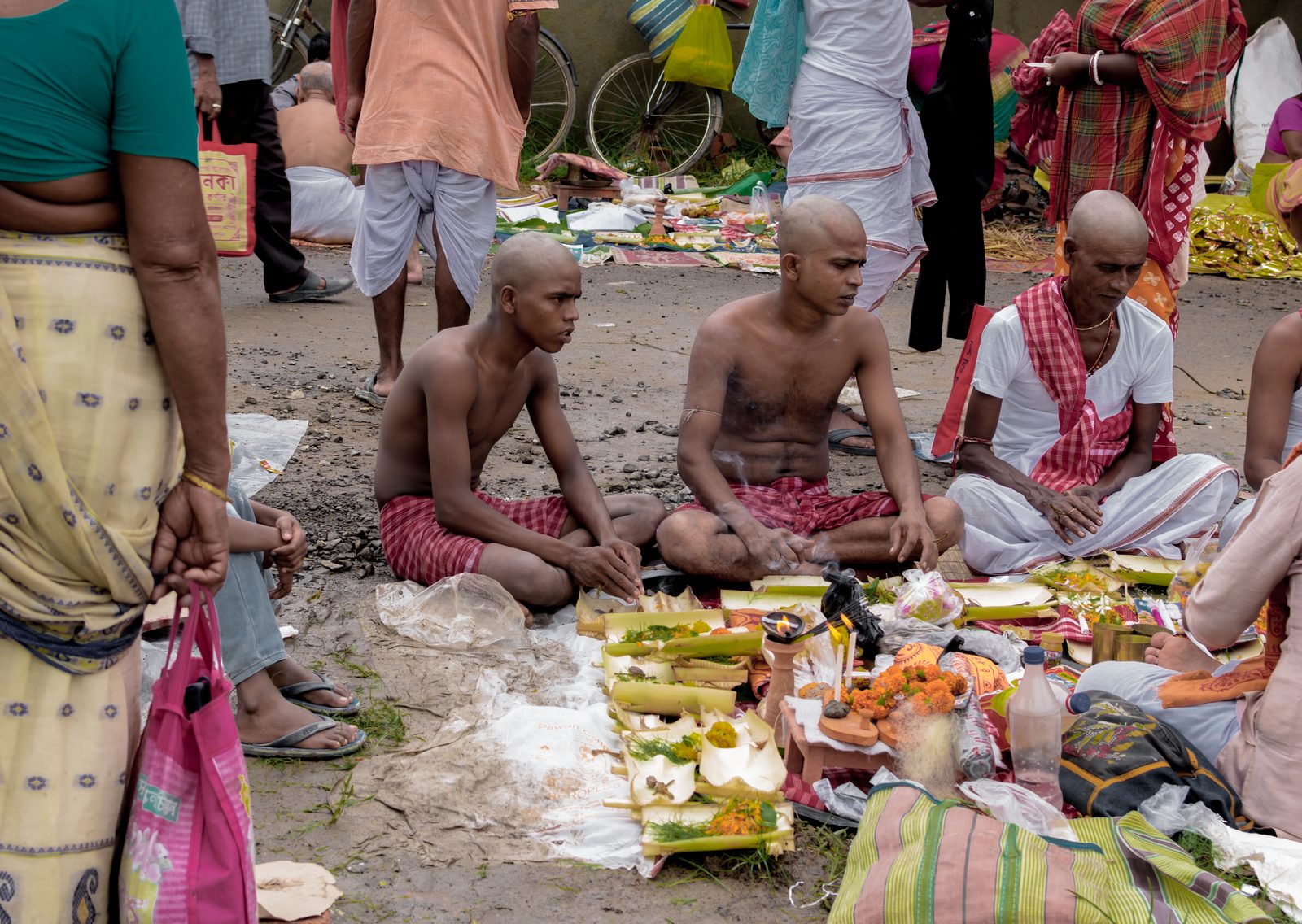
Pitṛ doṣa (पितृ दोष) is the charge that your ancestors are not at peace, that your chart shows it, and that nothing in your house will move until the matter is settled at a price. The oldest text standing behind those words says something close to the opposite: every person is born owing the ancestors, all of them, with no chart opened and nobody singled out.
The selling order is fixed. The dead come first. The chart comes second. Your own life comes third, and by then it is being read back to you as proof. I am describing the wording of the pages that take bookings, not any one conversation; the order is what stays constant.
Two of those three parts are true before anyone opens a chart. You do have dead people. Something in your family is not moving: a marriage that has not happened, a business that will not turn, an illness that keeps returning. Only the middle part needed a specialist, and it does the least work of the three.
Two separate ideas have been folded into this term, and the older one is not a fault at all.
The older idea is pitṛ ṛṇa (पितृ ऋण), the debt to the fathers. Ṛṇa is a debt in the ordinary sense: a thing owed, and repaid. Pitṛ (पितृ) means the fathers, meaning the ancestors, the dead of your own line.
The Śatapatha Brāhmaṇa, a long prose work on ritual from the Vedic corpus, states it in its first book. Julius Eggeling's English version carries the passage at I.7.2. A man is born owing. He owes study to the seers. He owes sacrifice to the gods. He owes offspring to the fathers, which the text puts as a line that is not to be broken. A fourth debt is named there too, owed to other people and discharged by hospitality.
Hold the shape of that up to the light. The debt arrives at birth, for everyone. Nobody is examined, nothing is detected, no chart is opened, and no fee is mentioned, because there is nothing here to sell. It is a description of being a person with parents. Later ritual law adds the śrāddha (श्राद्ध), the offering made to the dead, as the other way the same debt is served, and the calendar sets aside a fortnight of the year for it.
Everyone is born holding this debt, so it cannot also be a discovery about you specifically. That older article is a quiet one, and nothing in it has ever needed a counter. The modern term keeps its first word and changes the second, and the change is the whole business.
Doṣa (दोष) means a fault or a blemish: something wrong with a thing.
Go looking for pitru dosha as a heading in the standard classical corpus of jyotiṣa (ज्योतिष) and the heading is not there. What is there, in the Parāśara material, is a chapter on the effects of curses carried from a previous birth, numbered 83 in R. Santhanam's English edition. It is the strongest thing anyone defending the term can point to, so it deserves reporting carefully.
It gives combinations said to indicate the absence of a male child, and attributes them to curses: from a serpent, from the father, from the mother, from a brother, a maternal uncle, a brahmin, the wife, a departed spirit. Remedial measures are set out alongside.
Three details are worth keeping. The outcome named is narrow, and it is childlessness, not a slow business or a delayed marriage or a run of illness. The father is one item on a list of eight. And the word used is śāpa (शाप), a curse, which is something somebody did, rather than doṣa, which is something you have.
The article sold today is a defect. Its common form is the sun, which stands for the father, sitting with Rahu, or the ninth house and its lord under strain. Which arrangement counts depends on who is telling you. What that disagreement is worth I have set out elsewhere in this series; here it is not where the weight sits.
The weight sits in who the claim is about.
Every other flag in this trade makes its claim about somebody alive. Manglik is a statement about your chart; the matching flags are statements about two living people. This one is about the dead, and that changes what can be done with it.
Start with the accused. Whatever is alleged, it concerns people nobody can now ask: a rite left half finished, a wrong never put right, a death that came early and was never properly marked. There is no cross-examination available, and usually nothing specific to check.
Then the evidence. Go back three generations in any family and you will find a death that came too soon, a quarrel over property, a marriage that went badly, and at least one funeral conducted in a hurry during a war or a move or a year with no money. That is not a family secret. It is the ordinary contents of the last hundred years in this country. A family asked to search its own history for a fault will find one every time, and the finding will feel like confirmation. It is not. It is what searching does.
Then the test. Once the rite is performed, what would count as it not having worked? Nobody says. The relief afterwards is real and I do not doubt it, but the state people were in before they paid was worry, and worry lifts when the thing you were told to do is done.
And then the part that is not about reasoning at all. With a stone you can say no and be thought stubborn. Here, declining has been arranged to look like something worse: neglect of your own dead, in front of your family. The bill arrives dressed as loyalty. That is the move I object to. A stranger locating an obligation to your parents inside your birth chart, and then quoting a price for discharging it, is running a sale.
Follow the incentive, then, and follow it carefully, because what it leads to is not a fraud run out of a back room. It is old rites, real priests, published rates.
Two rites take most of the traffic. At Trimbakeshwar in Nashik they are sold together, over three days, as Narayan Nagbali. Both are older than the chart term that now sends people to them, and each had its own job. Narayan Bali belongs to the Garuda Purana material on death, and is for a death that was untimely or unnatural, so that rites can be given where the ordinary ones could not be. Nag Bali is expiation for having killed a cobra.
Read those two entry conditions again. Each turns on a fact somebody in the family would know: how a person died, or what was done to a snake. Neither turns on a pattern in a chart. The rites were not built as products, and I am not saying they were. What has been fitted to them is a new key, cut from three lines of birth data. This is not the first invented duty that town has been handed: I traced how kaal sarp arrived young but dressed as old doctrine in an earlier piece, and the same counters take bookings for both.
Then the prices, which are published, and which I read in July 2026. One Trimbakeshwar booking site quotes Rs 6,500 for the three days, with materials, stay and food included. A second publishes Rs 11,000, itemised as Rs 4,100, Rs 5,100 and Rs 6,100 across the three days with two pandits, and carries a Pitra Dosh Nivaran Puja at Rs 5,500 and a Tripindi Shraddha at Rs 2,251 to Rs 3,001. A third gives the range as Rs 7,000 to Rs 25,000 and above, before lodging and food.
Now move the same names to Gaya, the other address for this subject. One operator there lists Tripindi Shraddh at Rs 15,000, Narayan Bali at Rs 31,000, and pind daan for a single person at Rs 5,100. For families abroad the same page offers the rite performed on their behalf at that last price, with live video, photographs and a report.
Set the figures against each other. The same named rite is Rs 2,251 in one town and Rs 15,000 in another. The procedure does not change by a factor of ten between Nashik and Gaya. A rite has a method. A method does not have a price. What carries a price is the distance a worried person has already travelled, and the state they were in when they set out.
Let me be plain about what I am not saying, because grief is in this subject and deserves better than to be argued at. If you keep the rites for your dead, keep them. Remembering the people you came from is not a symptom of anything. Whether consulting anybody at all is steadying you or working on you is a different question, and Raman has written about how to tell those apart in astrology and the anxious mind.
What I am against is a sequence. Three lines of birth data are read. A cause is announced for what has gone wrong in your life. The cause is placed inside people who cannot speak for themselves. Then a rate card appears.
If you are in that conversation, three questions cost you nothing. Ask which text and which chapter, about the specific claim rather than about the tradition in general. Ask what the rite's own entry condition is, and whether your family meets it, since the two on offer were built for a particular kind of death and for harm done to a snake. Then, before anything is booked, ask what the same rite is charged at in two other towns.
The oldest sentence about this debt says a man is born owing it. Every man, on the day he arrives, before anybody has looked at anything. Nothing in that sentence was ever addressed to you in particular, and that is the part worth keeping.
Twice a week
Essays like this one, Tuesdays and Saturdays. One email per essay, and the archive is never mailed out. Subscriptions open shortly; the RSS feed is live now.
Nothing else arrives, ever.