The sceptic at the puja
What your hands do when the lamp comes round, why courtesy is not the same as lying, and the line a doubter can hold in a believing house.
Two ways in. The gist assumes you have never met any of this before.
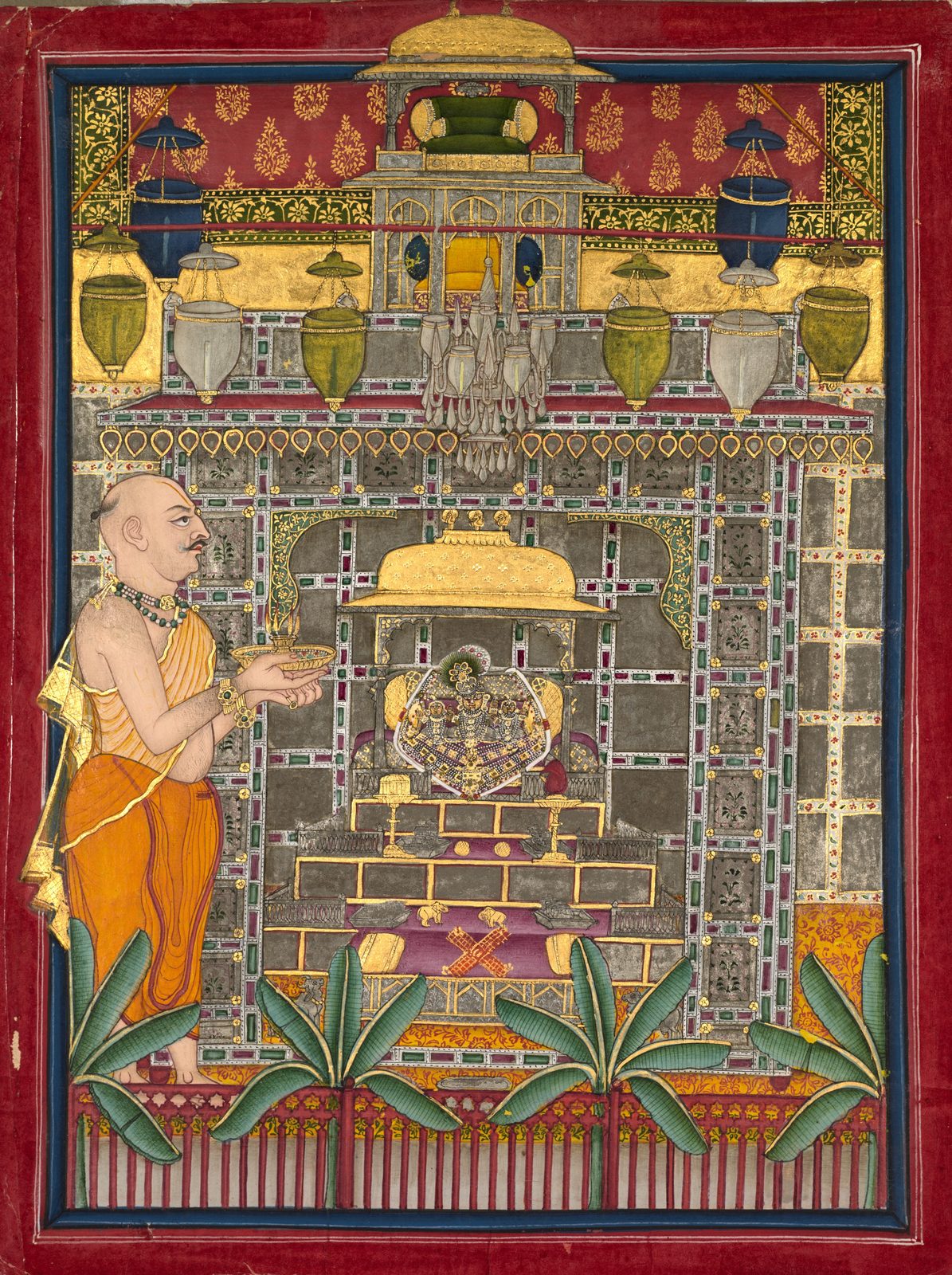
The sceptic in a believing family is easiest to find at the aarti (āratī, आरती), because that is the minute when the lamp comes round the room and every pair of hands in it has to do something. Watch hands, not faces. Faces get arranged in advance. Hands are slower, and they are the one part of the evening nobody rehearses.
Here is the sequence almost everybody else is doing. The tray comes level with you. The palms go out flat and hover over the flame for about a second, close enough to take the heat off it. Then they come up to the forehead and drop. Older hands manage all of it without once looking at the flame, the way you climb stairs you have climbed for fifty years.
The sceptic's hands do one of four things. They stay where they are, folded or at the sides, while the tray goes past. They take the tray and pass it straight on, the way you would move a hot dish along a table, joining the traffic and not the gesture. They begin the sequence and abandon it, so the palms turn over the flame and come down without going to the head. Or they do the whole thing half a beat late, which is where you are when you are copying the cousin in front.
None of the four is a position. They are four ways of getting through 11 seconds. What I think, the inside of the thing, is written down already in believing a little, and I am not arguing it again here. This piece is the outside: the room, the smoke, the knees, the tray.
An aarti is the shortest part of the evening and the most physical. The word comes from ārātrika (आरात्रिक), the waving of a light before an image at night. A lamp of ghee-soaked wicks, or camphor lit in a dish, goes in circles in front of the image while somebody sings and somebody rings a bell, and then it goes round the people. It closes the puja (pūjā, पूजा), the household worship it belongs to. Being physical is why it is the hard part for a doubter: you can keep your views to yourself all evening, and the tray still arrives at your chest.
There are two bills here, and the sceptic usually counts one.
Attending costs an evening, which is not nothing when you are home for two days, and your knees if people sit on the floor. There is smoke, and a stretch of language you follow about a third of. For the people around you the rite is something they are inside; for you it is something you manage: your hands, your face, the question that comes afterwards in the kitchen. Managing is more tiring than taking part.
The other bill is the one sceptics leave off the table. An empty place is read too, and it is read as a sentence about the people rather than about the doctrine. The corridor is a gesture in the same way the room is.
What attending gives back is smaller than a believer would claim and larger than a doubter expects. It is one of the few occasions when four generations are in one room, at the same height, facing the same way. You learn the household's real order in a minute: who leads, who is allowed to correct, who has not been given a job in years and minds it.
Something else goes unmentioned. Half the room is not in a state of conviction either. In a house like this one there is always a grandmother whose hands do the whole sequence while she works out whether the milk has been covered. No particular grandmother, no particular evening. A rite is a body's habit as much as anything else. That helps for a day. Then you notice that you can stand in a room of half-attending believers and still feel like the only person there under false pretences. I think that feeling is mistaken, and not for the flattering reason.
What the gesture claims
Hypocrisy is a specific offence and worth keeping specific. It needs three parts: an assertion, a belief you do not hold, and something you get by making it. Take the assertion away and what is left is manners.
So what does holding your palms over a flame assert?
Very little on its own. A gesture is not a sentence you compose; it is one the room wrote long before you arrived, and all you choose is whether to say it. Its meaning is set by the people who use it every week, and what they take it to mean when you do it is nearer to "I am here, and I am not going to make this difficult" than to any claim about the divine.
The shape of the rite says the same thing, and says it more precisely.
A puja is built on hospitality. The long form runs to sixteen services, set out by the Indologist Jan Gonda, and they are what a household does for an arriving guest: invite him in, seat him, wash his feet, offer incense, wave a lamp, feed him, see him off. Paul Thieme suggested, from passages in the Ramayana, that the word puja meant the hospitable reception of guests before it meant anything else. Whatever a household holds about who the guest is, the grammar of what it does is the grammar of receiving somebody at a door.
Hosting has never required agreement. You have carried a visitor's bag up the stairs without holding a view about the trip. At a funeral you take your turn under the bier without claiming to know where the person has gone. That is the ordinary business of standing in a room with people whose lives are not yours to run.
Then look for the moment in a household puja when somebody is asked to affirm something. There is one declaration in the evening: the sankalpa (saṅkalpa, संकल्प), which fixes the day, the place, the household and what the rite is being performed for. Monier-Williams gives the word as a declaration of purpose. It states what is being done and for whom, not what anybody thinks is true, and it is made once, by one person: the yajamana (yajamāna, यजमान), the one at whose cost and on whose behalf a rite is performed, as against the priest employed to perform it. Nobody turns to the back of the room.
I am reading the shape of the event and not its theology, and a priest would put much of this differently. Scholars have a word for traditions like this one: orthopraxic, meaning what matters is doing the practice correctly rather than what you believe while you do it. The word oversimplifies, and plenty of Hindus would say belief is the centre of the matter. The claim I need is narrower. The rite in your grandmother's front room has no place in it where you are asked to declare.
Hypocrisy is genuinely available at a puja, only not at the tray. Like every version of it, it has a gain inside it.
The commonest is taking the credit. Somewhere in most families is a person who reads your presence generously and tells two others that you have come round at last. If you let a reading you know to be false stand because it buys you a quiet month at home, you have made the assertion after all, by silence. The repair is one sentence, a week later: I come for the evening, and nothing else has changed.
The other version is wanting the benefit of a thing you have opted out of: hoping the family holds a puja for your interview in March while planning to be elsewhere in June.
The line, and how to hold it
Almost nothing in a household rite is compulsory. What is asked is that you be in the room and not make the room about you. Inside that, the line is easier to hold than people expect, and it wants drawing in an unremarkable month, not at the tray.
You can decline to be the person the rite is for. There is a real difference between an aarti you attend and a rite arranged in your name, with your birth details read out. The first asks nothing of you. The second puts your name in the sankalpa. Say you would rather not be the subject of one, and say it before anything is arranged. Said in the week itself, it lands on somebody who has already made the calls.
You can decline the interior questions. Did you feel anything, did something happen, be honest with me. You may say that you do not know, and mean it, and ask once, without heat, not to be told what you felt. That half of the line is the family's as much as yours. Nobody in the house is entitled to describe your inner condition to anybody else as settled.
What is not available is the loud version of not taking part. Folded arms at the back, the phone out, the tight smile during the singing, stepping into the corridor as the tray starts round. All of that is a speech, and it is louder than any pair of hands over a flame. Say your position in words instead, on another day, when nobody is holding a lamp.
Two small ones. Do not explain camphor to the child standing next to you. And take the prasad (prasāda, प्रसाद): dictionaries trace that word through clearness, calm and kindness long before it comes to mean food, and what is happening is that somebody is holding something out to you with both hands. Refusing it is not a statement about the universe. It is refusing a person, in front of her relatives, over a spoonful of semolina.
The lamp reaches you either way. Hold your palms over it or do not, and then take the tray in both hands and pass it to the person on your left, who has been waiting, and whose knees are worse than yours.
Twice a week
Essays like this one, Tuesdays and Saturdays. One email per essay, and the archive is never mailed out. Subscriptions open shortly; the RSS feed is live now.
Nothing else arrives, ever.