Computed sky · Meghnad Chitnis
The tilt that sets the seasons
The obliquity is 23° 26′ 09″ and falling. What owns that number, where it enters a chart, and one birth recomputed under three different tilts.
Two ways in. The gist assumes you have never met any of this before.
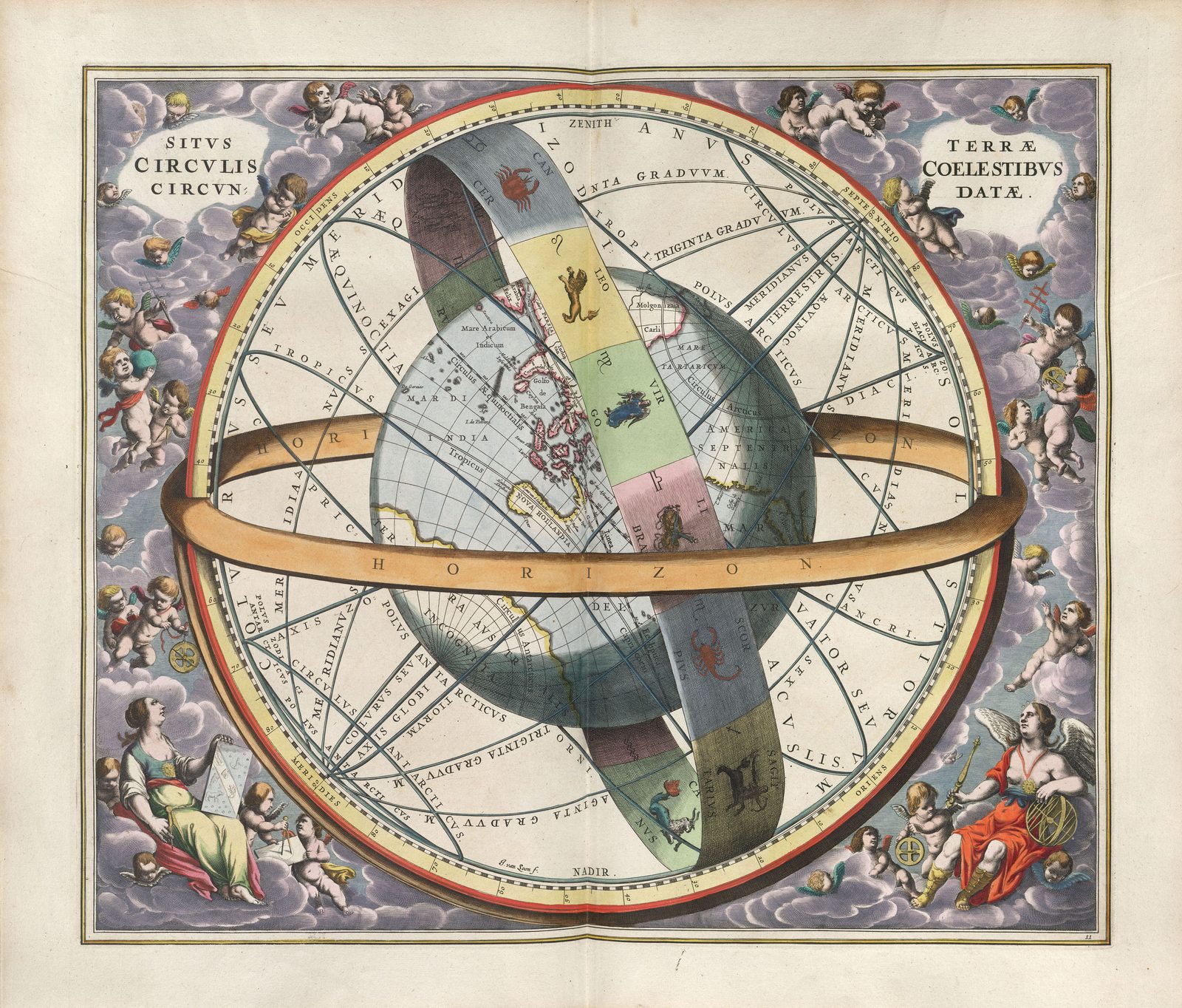
The obliquity of the ecliptic is 23° 26′ 09″ for 2026: the angle between the plane of the earth's equator and the plane of its orbit. It is the tilt that puts seasons in a year. It is one of exactly three numbers behind every rising degree ever printed. And it is not fixed. It is falling by roughly 47 arcseconds a century, and the thing doing the falling is not the axis.
Two slow motions get confused here, and they are worth separating first.
The Sun and the Moon pull on the earth's equatorial bulge, and a spinning body pulled sideways swings its axis around a cone. That is precession, one turn in a little under 26,000 years, and it has a page of its own. Precession changes where the axis points. It leaves the lean of the axis very nearly alone.
The lean changes for another reason. The other planets tug at the earth's orbit, and the orbital plane tips slowly against the fixed stars. The obliquity is measured from that plane, so a plane that moves changes the angle while the axis does nothing at all. The floor is tilting, not the pole.
The value itself comes out of one published line. Let T be the number of centuries since the beginning of 2000:
ε = 23° 26′ 21.406″ − 46.836769″ T
Three further terms follow it, small enough to matter only across thousands of years. The leading figure is the value adopted for 2000 in the current international convention; the second is the present rate. For the start of 2026, T is 0.26, the subtraction is 12.18 arcseconds, and ε is 23° 26′ 09.23″. The older expression Jean Meeus prints begins at 21.448″ instead and lands on 09.28″ for the same date. Five hundredths of an arcsecond between two standards is a fair measure of how well this constant is known.
One qualification, since the first sentence claimed an arcsecond. That figure is the mean obliquity. The axis nods as it precesses, and the true value swings either side of the mean by up to about 9 arcseconds on a cycle of 18.6 years. A program carrying only the mean is out by that much and seldom says so.
A falling number invites a bad question: what happens when it runs out. It does not run out. Across long spans it is a swing, not a slide. Over the past five million years the tilt has run between 22° 02′ 33″ and 24° 30′ 16″, with a mean period near 41,000 years. The last maximum was around 8700 BCE; the middle of the swing was crossed some time in the sixteenth century; the next minimum falls near the year 11,800. The swing is that narrow because of the Moon. Laskar, Joutel and Robutel showed in 1993 that the Moon's share of the torque keeps the earth clear of a chaotic zone, holding the variation to a little over a degree either side of the mean; without the Moon the same equations let the tilt wander from near zero to about 85 degrees. The constant is steady by an accident of this solar system, not because tilts are naturally steady.
Where it enters
Four places, and they are not equally exposed.
Planetary positions arrive from an ephemeris in equatorial coordinates and a chart wants ecliptic ones, so a rotation by ε sits at the front of the pipeline. The midheaven, the degree of the ecliptic crossing the meridian overhead, comes from the sidereal time and the tilt and nothing else. The lagna (लग्न), the rising degree, takes the sidereal time, the latitude and the tilt. And the declination of any body is got from its longitude and the tilt, which is what the rising times of the signs are built on.
The tradition names the same constant. It is the paramakrānti (परमक्रान्ति), the greatest declination: the furthest the Sun gets from the equator across a year, which is the tilt seen from the other side. The Surya Siddhanta's rule for declination, in Ebenezer Burgess's translation of 1858, gives the sine of the greatest declination as 1397 in a radius of 3438. Take the arcsine of 1397 ÷ 3438 and you get 23° 58′ 31″. The text works with 24 degrees, and the rising times tabulated in those books follow from it.
That supplies a counterfactual worth computing rather than arguing about, and not a fanciful one: it is the tilt Indian astronomy actually used.
One chart, three tilts
The essay on raising the ascendant by hand took a hypothetical birth at Ujjain on 22 July 2009, carried the clock reading to a local sidereal time of 4h 45m 15s, and used the obliquity for that date, 23° 26′ 17″. Its answer was a tropical ascendant of 162° 52′ 07″. Two of the five trigonometric values in that working depend on the tilt and three do not, so the counterfactual is cheap:
tan λ = −cos θ ÷ (sin ε × tan φ + cos ε × sin θ)
θ is the sidereal time as an angle, 71.3125 degrees, and φ the latitude, 23.1833 degrees. cos θ is 0.32041, sin θ is 0.94728, tan φ is 0.42826, and none of the three knows anything about ε.
Run it at 24 degrees. sin ε is 0.40674 and cos ε is 0.91355, so the bottom line is 0.40674 × 0.42826 + 0.91355 × 0.94728 = 0.17419 + 0.86538 = 1.03957. With the modern value the same two products were 0.17034 and 0.86912, adding to 1.03946. Divide the unchanged top line: −0.32041 ÷ 1.03957 = −0.30821, against −0.30824.
Ascendant = 162° 52′ 13″.
Six arcseconds. The first product rose by about four thousandths and the second fell by about four thousandths, and they very nearly cancelled. Push the tilt to the ends of its long swing and the cancellation holds: 24° 30′ gives 162° 52′ 13″, and 22° 06′ gives 162° 51′ 30″. Forty-one thousand years of Milankovitch swing moves this rising degree by 44 arcseconds, which at the ascendant's usual rate of about 15 arcminutes a minute is three seconds of clock time.
That is not a general result, and it would be a poor lesson to take from it. The cancellation belongs to this sidereal time. One relation underneath the formula explains it. For any rising point, subtract its ascensional difference from its right ascension and you get the sidereal time plus 90 degrees. Now take a point where the equator crosses the ecliptic: it has no declination, so no ascensional difference either, and its right ascension is simply its longitude. So that point rises at sidereal time 6h at one crossing and 18h at the other, whatever the tilt, and the rising degree at those two moments is 180 and 0 exactly. Our birth stands an hour and a quarter from one of them. The same latitude, the same two tilts, at seven readings of the clock the sky keeps:
| Local sidereal time | With 23° 26′ 17″ | With 24° | Difference |
|---|---|---|---|
| 4h 45m 15s | 162° 52′ 07″ | 162° 52′ 13″ | +0′ 06″ |
| 6h | 180° 00′ 00″ | 180° 00′ 00″ | 0 |
| 9h | 220° 48′ 11″ | 220° 45′ 59″ | −2′ 11″ |
| 12h | 260° 19′ 58″ | 260° 07′ 08″ | −12′ 50″ |
| 15h | 304° 04′ 55″ | 303° 42′ 41″ | −22′ 13″ |
| 18h | 0° 00′ 00″ | 0° 00′ 00″ | 0 |
| 21h | 55° 55′ 05″ | 56° 17′ 19″ | +22′ 13″ |
The worst the classical constant can do to a rising degree at this latitude is 22 arcminutes, and it does that only near two particular hours. In clock terms it is a minute and a half of doubt about the birth time. Across the full 22° 06′ to 24° 30′ swing the same worst case widens to 1° 34′.
The midheaven is less forgiving, and its formula says why. It is tan λ = tan θ ÷ cos ε: the sidereal time and the tilt, no latitude, and nothing to cancel against. For the same moment it stands at 72° 45′ 33″ with the modern value and 72° 49′ 45″ with 24 degrees, 4 arcminutes apart, and runs from 72° 36′ to 72° 54′ across the long swing. Whole-sign houses make no use of it. A cusp system does, and every cusp on the page moves with it.
The last place surprised me. Take a body that truly sits on the ecliptic. Convert it into equatorial coordinates with the correct tilt, then convert it back with 24 degrees instead, an error of 34 arcminutes. The longitude you get back is wrong by at most 5 arcseconds, and by nothing at all at 0, 90, 180 and 270 degrees. The whole 34 arcminutes goes into the ecliptic latitude, which comes back that far from zero. A tilt half a degree out barely touches the column a chart prints and lands its entire error in the column a chart leaves off.
So this constant has an odd standing among the inputs. It is the easiest number in the calculation to be right about, one subtraction from a published line, and its value in a thousand years is already known, which is not true of the clock a chart is handed. And it can be half a degree wrong and still leave nine of the ten numbers on the page unmoved. I carry it to hundredths of an arcsecond anyway, and not out of scruple. When two charts disagree you want a short list of suspects, and this is how a number gets struck off it.
Twice a week
Essays like this one, Tuesdays and Saturdays. One email per essay, and the archive is never mailed out. Subscriptions open shortly; the RSS feed is live now.
Nothing else arrives, ever.