The book you could carry in your head
Varahamihira's Brihajjataka in numbers: twenty-eight chapters, a little over four hundred verses, and what that compression cost and bought.
Two ways in. The gist assumes you have never met any of this before.
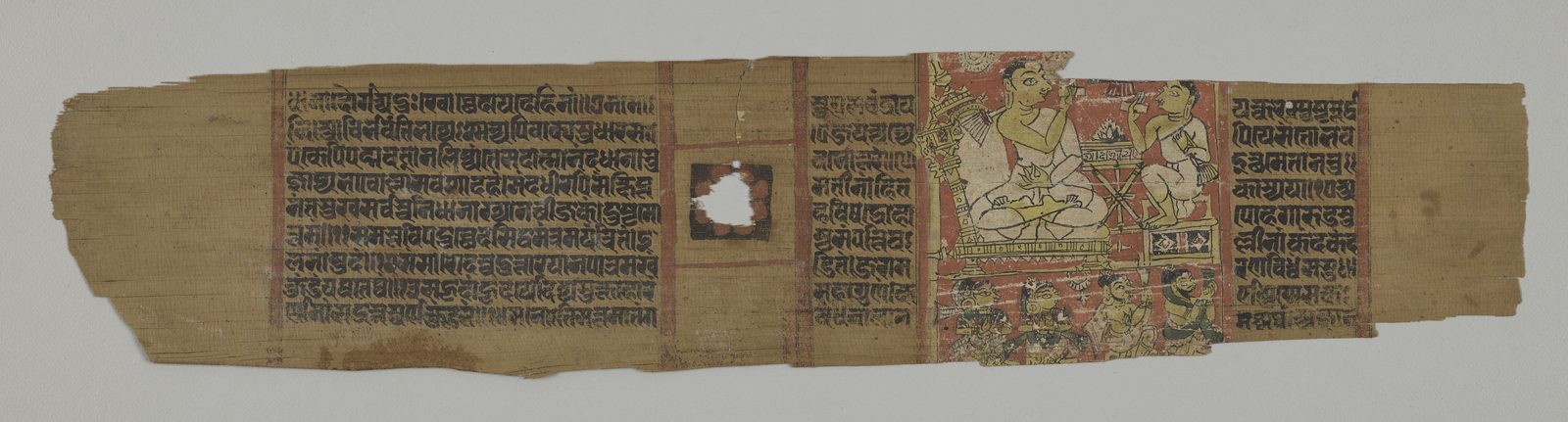
Bṛhajjātaka (बृहज्जातक) means the large book of nativities, and Varāhamihira's sixth-century book of that name is not large: twenty-eight chapters hold the whole of its doctrine of the birth chart, and it is the handbook this tradition actually taught.
The verse count is worth stating carefully. Four hundred and nine, if you take the chapter counts in the Sanskrit text transliterated by Mizue Sugita, which Sanskrit Documents publishes, and add them up. Editions divide the lines a little differently. The first chapter runs to twenty verses there, and to nineteen stanzas in the English translation N. Chidambaram Iyer printed at Madras in 1885. The figure most often given for the whole is a little over four hundred.
The word large in the title separates it from the shorter book on the same subject that Varahamihira also wrote. It is a small book about a large subject, and nearly everything worth saying about it follows from that.
Look at how the space is spent. Chapter ten is about how a person will earn a living, and it is four verses long. Chapter nine sets out aṣṭakavarga (अष्टकवर्ग), a scheme in which each planet's placements are scored good or bad from eight separate reference points, and it is eight verses. Chapter fifteen, on the chart of someone who leaves ordinary life to become an ascetic, is four. Chapter twenty, on the twelve houses into which a chart is divided, is eleven.
The longest chapter is the twenty-seventh, and it is long for a reason that proves the rule. It gives the drekkāṇa (द्रेक्काण), the third part of a sign, in thirty-six verses. Twelve signs, three parts each, one picture for each part. A list of images cannot be squeezed, because every item has to be said once. Everywhere the book is not listing, it is compressing hard.
Varahamihira states his intention in the second verse of the first chapter. I paraphrase from Iyer's translation rather than quote it: well written works on the subject already exist for able students, and for those whose attempts have broken down he is building a small boat, made of stanzas in various metres and carrying several meanings apiece.
Both halves of that description matter, because between them they are the price and the purchase.
Take the metres first. Sanskrit teaching books are in verse because verse can be checked. A line that scans has probably come through copying intact, and a line that has lost a syllable declares itself to the ear of anyone reciting it. Metre is protection for a text that will spend more of its life in memories than in boxes. Varahamihira did not use one easy metre throughout, as many manuals do. He used many, and several of them are long and intricate. That is harder to compose, and harder to learn, and, I think, harder to corrupt without somebody noticing.
Now the several meanings, which is the cost. Iyer says plainly that many of the stanzas are meant to carry more than one sense, and that four commentaries had grown up around the book because of it. A compressed verse in an elaborate metre is a memory aid rather than an explanation. It is built to be recited by someone who has already been told what it means. Taken off a shelf by a reader with no teacher, much of this book is a wall.
There is a second cost, and it is the one that troubles a historian more. Compression keeps conclusions and throws away arguments. Chapter seven, on the length of a life, runs to fourteen verses. In those fourteen verses he names five earlier authorities one after another: Satyacharya, then Vishnugupta, Devasvamin and Siddhasena together, then Jivasarman. Each had a method. Each gets summed up in a single phrase. Some he takes over. Some he rejects. V. Subrahmanya Sastri's translation explains the objection to one group of them: their method cannot produce a lifespan shorter than twenty years. That is five competing systems handled in the space of a page. Their own books are, for the most part, gone. What survives of several of these men is a name in a list, and quotations lodged in the work of later commentators.
The gloss that grew back
About four centuries after Varahamihira, a scholar called Bhaṭṭotpala set out to explain the book line by line. Al-Biruni, writing about India around 1030, says he was a Kashmiri. He commented on the Brihajjataka, in a work called Jagaccandrikā and also known as Cintāmaṇi; on Varahamihira's encyclopedia, the Brihat Samhita; on his smaller book of nativities; and on Brahmagupta's manual of computation, the Khaṇḍakhādyaka. More than any other person, he is the reason the compact book stayed usable.
His own date is the ordinary difficulty of this literature in miniature. He closed two of these commentaries with the year, the month, the lunar day and the day of the week, which is a great deal more than most Sanskrit authors leave behind. The year is 888 of what he calls the Shaka reckoning. Read as the Shaka era, which runs seventy-eight years behind the common era, that gives 965 or 966, and that is the date reference works print. Ajay Mitra Shastri has argued that Utpala meant the Vikrama era instead, which would move him back to about 830. Bill Mak's study of him, published in 2018, keeps him in the tenth century, and that remains the working position. So: a colophon precise to the weekday, and about a hundred and thirty years of doubt over which era it counts by. The man who fixed the meaning of the text cannot himself be securely fixed.
What he did for it is easier to state. Utpala quotes a great deal that survives nowhere else, including material attributed to Garga, to Parashara and to Rshiputra. Some of what the root text had compressed away comes back in the prose of the man explaining it. That is the shape of the whole arrangement: the text is short because a teacher was assumed, and the teacher's notes are where the discarded material was kept.
The glossing did not stop with him. Iyer, in 1885, records four commentaries in circulation, says Bhattotpala's is the well known one, and mentions that two of the four were on his own desk as he worked. In Kerala the line runs differently. Govinda Bhattathiri of the Talakkulathur house wrote a commentary on the whole book in the thirteenth century and called it Nauka, the boat, taking up the author's own image. What became the teaching book in Kerala, though, was the Daśādhyāyī, the Ten Chapters: an abridgement that covers only the first ten. A shortened commentary on an already short book turned into a classic of its own. Counts of the surviving commentaries differ from one reference work to the next, some saying twenty, others many more, and I would not put a figure on it.
What the smallness bought
Set this beside the tradition's largest book. The Bṛhat Pārāśara Horā Śāstra comes in ninety-odd chapters in the edition most Indian readers own, and carries no commentary older than the last century. The compact book carries a shelf of old ones. I think those two facts are connected, and the connection runs in a circle. A book gets commented on because it is being taught. It can be taught because a student can hold all of it. Once the commentaries exist, teaching it becomes easier still, because the gloss supplies what the verses left out.
Think about what a student actually had to acquire. Four hundred verses is a serious labour of memory and no more than that: months of work, not years. A copy fits on a few dozen leaves and travels in a cloth. Once it is in the head it travels for nothing, and it arrives whole, which a bundle of palm leaves in a damp climate does not reliably do. A teacher in a town with no library could still teach the entire subject, because the entire subject was inside him. That is what the economy bought, and it is why the compact book, and not a fuller and kinder one, became the thing everybody learned.
Chapter twenty-eight, the conclusion, is ten verses. Inside them Varahamihira says who his father was and where he received the favour of the Sun, and those few sentences are the reason he is the one classical author who can be placed in a century. Even his own account of himself is compressed to the point of argument.
And chapter ten is still four verses long. The trade or the office or the land a person will live by, the whole working half of a life, in four verses a student could have by heart before the afternoon was out. Not a short answer to a large question: a short reminder, set down for a reader who had already been given the long one.
Twice a week
Essays like this one, Tuesdays and Saturdays. One email per essay, and the archive is never mailed out. Subscriptions open shortly; the RSS feed is live now.
Nothing else arrives, ever.