Building a year planner from a panchang
A year of a family's dates fits on one sheet of paper. What to take off the almanac, in what order, what to check, and what to leave in the book.
Two ways in. The gist assumes you have never met any of this before.
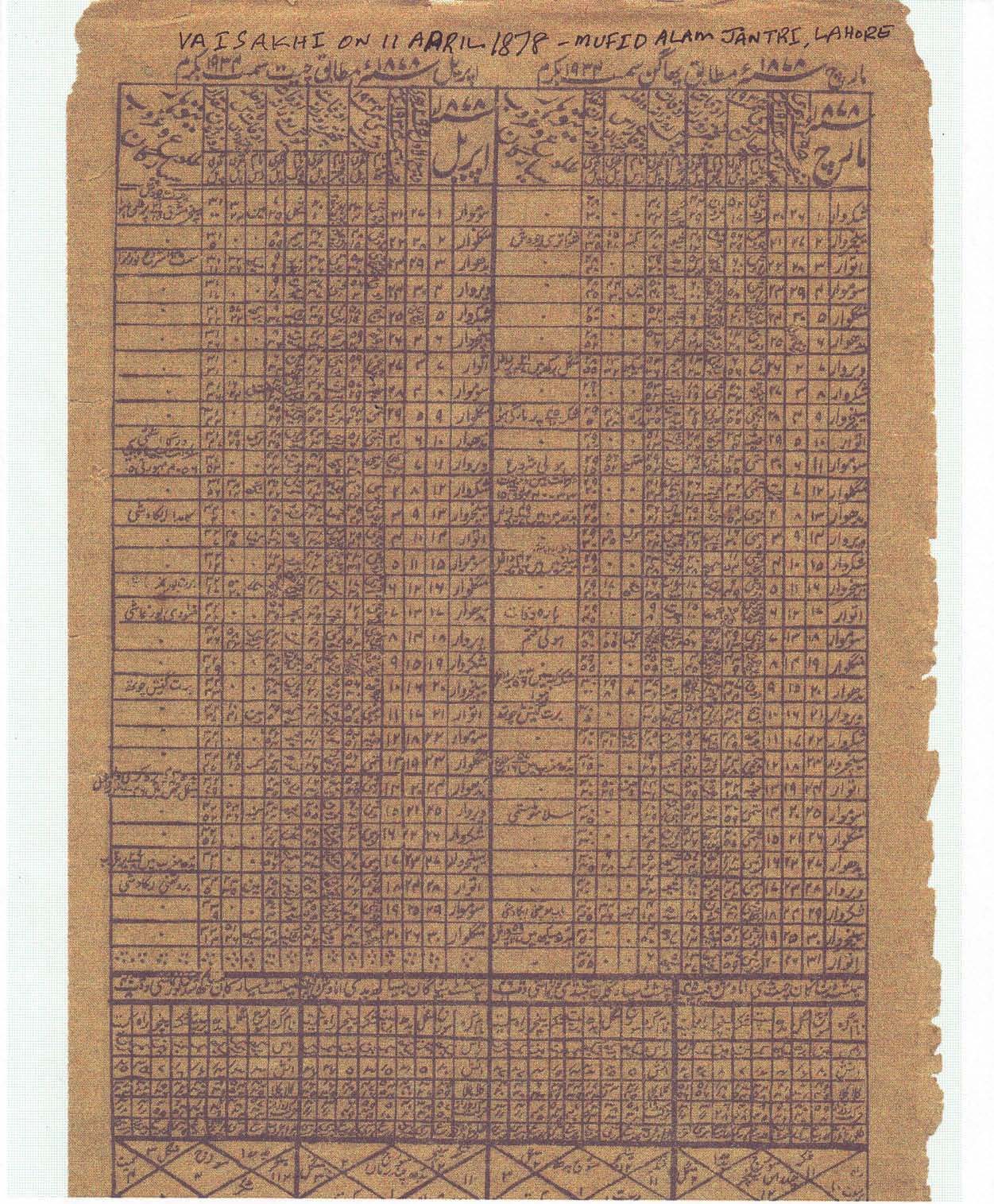
A year of a family's dates fits on one sheet of paper. Mine is a single page, ruled into twelve blocks with a pencil and the edge of a book, taped inside the kitchen cupboard door, where it gets read most days by somebody who did not mean to read it.
There is less on it than you would expect. Each block carries the month's name twice at the top, once in English and once in the reckoning this house uses. Under that, between three and seven lines, and every line is a date and four or five words. All of it is in pencil except the handful of dates that other people have to be told about, and those are in ink. Down the right edge of each block runs a narrow column of bare numbers with nothing written beside them, which is the fasts that come round twice a month. At the foot of the page, in small letters, sit two facts: the name of the almanac all of this came off, and the city that almanac was computed for.
That is the whole object. No hour windows on it, no warnings, nothing on it that anybody has to be careful about.
It cost one afternoon at the table, with the fat annual panchang (pañcāṅga, पञ्चाङ्ग) open at the page where it gathers the year's festivals, a wall calendar beside it for the English dates, and a pencil. The afternoon has an order to it, and the order is the only part of this worth teaching, because it is not the order the almanac prints things in.
Hardest to replace first
Sort what you are taking off the sheet by what it would cost you to get it wrong, and begin at the expensive end.
The first pass is for the five or six dates that need leave, a train, or an invitation. The rite the family gathers for. The two festivals people come home for. A wedding somebody has already warned you about. These go in ink, because they are the ones where noticing two weeks late costs money. They are also the ones an office wants early. Central government offices in Delhi keep 17 gazetted holidays, with two more that each employee picks from a longer restricted list, and that choice is easier to make when the year is already on a wall.
The second pass is the long one, and it is for the dates nobody prints for you.
A birth tithi. The śrāddha (श्राद्ध), the yearly rite for a parent. The fast one person in the house keeps and nobody else does. None of these is on the festival page of any almanac, because they belong to your household and to no other, and each has to be looked up on its own, with the person who remembers them sitting near enough to be asked.
Here is the part that turns this from a yearly chore into a five-minute job. Do not go hunting for last year's date. Go and get the name.
A janma tithi (जन्म तिथि), a birth tithi, is a name in three pieces: the month, the fortnight, and the number. Bhadrapada, dark fortnight, the eighth. Once somebody in the family has given you that, it is yours for good, and every year after this one you are only turning a name into a date, which is a two-minute search in any almanac or app. Keep those names somewhere other than the planner, on a card in the back of the book. The planner holds this year's answers. The card holds the questions, and the card outlives the planner.
The third pass is the big festivals: do them late and do them fast. Every calendar in the country prints them, relatives will remind you whether you ask or not, and if one is left off the sheet it will be missing for about four hours before somebody says so.
The fourth pass is last and lightest: the repeats. Ekādaśī (एकादशी) twice in every lunar month. The full moon and the no-moon day. The monthly fourth, or the monthly eighth, if your house keeps one. These are the most numerous things you will write and the least costly to get wrong, for one plain reason. A missed festival is missed for a year. A missed ekadashi comes round in a fortnight. That is why they belong in a thin column of numbers down the edge rather than in the body of the month. An ordinary year holds 24 of them, and a year with an extra lunar month in it holds 26.
Three checks before it goes on the wall
The first check is the city. A day here begins at sunrise, sunrise is a local event, and the sheet you have been copying from was computed for one named place. If that place is not yours, then once or twice in a year a tithi (तिथि), the lunar day, will change over inside the gap between its sunrise and yours, and hand you a different date. Which day is your fast, actually works that rule through on real sheets. The checking is quicker than the reading: for the dates you put in ink, find the lunar day's start and end times and ask whether it was running when the sun came up over your own town.
The second check is for ekadashi, if the house keeps it. Some months carry two dates, one printed under the other, with a small word beside the second, and ekadashi, and why two dates circulate sets out where that second line comes from. For the planner there is only one thing to settle: which of the two lines is your family's, asked once of whoever keeps the observances. Then take that same line all 24 times. A sheet that follows the top line in March and the second line in July has invented a practice nobody in your family has ever kept.
The third check is the one people skip every year. Do not build this year's sheet by copying last year's and shifting everything along a little.
Twelve lunar months come to about 354 days and the solar year to a little over 365, so a date pinned to the moon falls roughly 11 days earlier against the English calendar each year. Diwali falls on 8 November in 2026 and on 29 October in 2027. Use that gap as an estimate and never as an answer. It tells you which fortnight to look in; then you look the date up properly.
If instead the date has moved nearly three weeks later than last year, rather than 11 days earlier, the year has an extra lunar month in it. That is an adhika māsa (अधिक मास). The year 2026 carried one, an added Jyeshtha from the middle of May to the middle of June, which is why that year's festivals stood so late against the English dates.
What stays in the book
Now the part that takes a little discipline, because the almanac will offer you a great deal more than this and some of it will feel important.
Leave the day windows where they are. Rahu kaal (राहु काल) and the two windows printed beside it, the muhūrta (मुहूर्त) rows a sheet marks as poor, the minutes set aside off the moon's station: none of them belongs on a year planner, and the first reason is arithmetic rather than argument. Every one is a share of a single day's daylight, cut fresh each morning out of that morning's sunrise and sunset, and cut differently for every city. A window copied onto a wall in July is wrong by August. There is nothing there to carry forward. They are not dates.
The second reason is about what a sheet on a wall does to a house, and I want to put it gently, because I have watched it happen in perfectly calm households where nobody was frightened of anything.
A planner answers a short list of questions. Can we travel that week. Do I need to ask for leave. Should the cousins come before the festival or after. It gets read a few times a month, usually by somebody standing up with the car keys already in one hand, and then it is left alone.
A sheet that also lists what to avoid gets read every morning. It has changed jobs without anybody deciding that it should. It is no longer a timetable but a set of standing instructions, and a household that consults a wall each day about what to be careful of has taken on a piece of work the almanac never asked of it, and one that no amount of reading ever finishes.
So there is a test for a doubtful line, and it is a kind one. If you cannot say in a single sentence, out loud, to whoever else lives in the house, what that line is for, it does not go on the sheet. Ma's fast, the eighth. Nani's shraddha. Diwali. Leave on the ninth. Each of those passes in four words.
Nothing is being taken from anybody here. The almanac stays on the shelf, and everything you left out of the planner is still inside it, ready for the one morning in the year when somebody wants it.
Do not attempt the whole year at a first sitting. Take one month, the one your household argues about most, and rule a single block for it on the back of an envelope with the clock running. Ten minutes is about right for a first block, and the second will be quicker.
Then, when there are twelve of them, write the almanac's name and its city at the foot of the page in small letters. That line is not for you. It is for whoever takes the sheet down next year and wants to know where the dates came from.
Twice a week
Essays like this one, Tuesdays and Saturdays. One email per essay, and the archive is never mailed out. Subscriptions open shortly; the RSS feed is live now.
Nothing else arrives, ever.