Nakshatra files · Yamini Sardesai
Mrigashira: the head that keeps turning
Three faint stars make the head of Orion, and they come up ahead of the rest of him. Also, why the word for road began as the word for a deer's track.
Two ways in. The gist assumes you have never met any of this before.
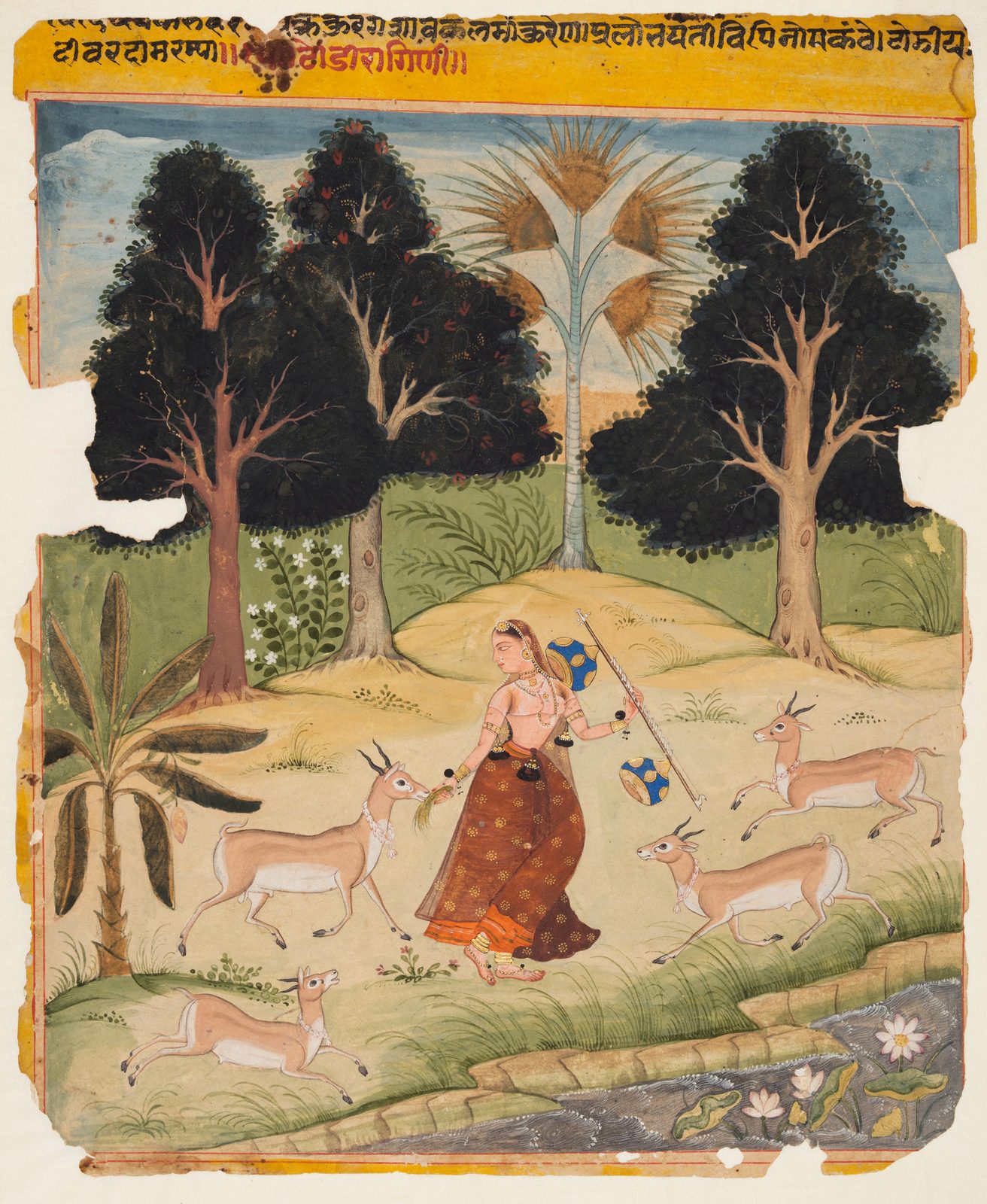
Mṛgaśiras (मृगशिरस्), the deer's head, is the fifth of the 27 stations the moon crosses at about one a night, and it is a small blunt triangle that almost nobody looks at. In the middle of August the eastern horizon hands it up second of four things, in the same order every morning. Rohini first, the orange one, well clear of the rooftops before anything else has started. The triangle a little after two. Twenty minutes behind it, three bright stars in a short straight row. And at 4:15, last and lowest, the brightest star in the sky.
Those four are the cast of one very old story: a doe, the stag who went after her, the arrow, and the hunter who let it go. They rise in that order, all but the hunter, who comes up last of all, after the animal he shot.
The triangle is the one this file is about.
It is a small thing. The whole triangle would sit inside a circle less than a degree across. Two of its stars stand side by side as they rise, about a moon's width apart, and the third hangs below the right-hand one. The brightest is the left-hand star of that pair, Lambda Orionis, which since 2016 the catalogues have also called Meissa: a hot giant well over 1,000 light years off, the exact figure still argued over. It sits at the middle of a loose young cluster, stars that formed together a few million years ago, which for a star is last week. The other two, phi-1 and phi-2, look like a matched pair and are nothing of the kind. Phi-1 is nearly as far away as Meissa; phi-2 is a yellow giant at 114 light years, 10 times nearer.
Meissa is about magnitude 3.4, and magnitude is the old backwards scale: the bigger the number, the fainter the star. A city sky stops at 3.5, 4 if rain has washed the air, and the other two are fainter than Meissa. So this is not a terrace nakshatra. It wants the place where your town stops lighting itself: a school ground, a maidan, the dark side of a water tank. A low eastern horizon, and 20 minutes without headlights.
It also wants patience, because your eye will not take these four in the order the horizon offers them. Brightness decides what you get first. What arrives for you first is that row of three, low and off to your right, standing nearly upright as it comes out of the horizon. It is the belt of the figure the West calls Orion. Up and to the left of it are two bright stars, one higher than the other: the upper right-hand one white, the lower left-hand one distinctly orange. The orange one is Betelgeuse. Go straight up from it, half a fist held at the end of a straight arm, a little over 5 degrees. There is nothing bright there. Wait, let your eyes finish arriving, and the blunt triangle comes out of the dark, level with the white shoulder star, Bellatrix, away to its right.
Those times are for Delhi, and for the middle of August. In the first week of the month the head clears the horizon nearer 2:50, and it gains four minutes a night. The 20-minute lead over the belt is a northern figure; from the south the gap is smaller. Rising is not seeing. Give it an hour to climb out of the smoke: at four it stands about 24 degrees up from Delhi and higher from Kolkata, the sky is properly dark until 4:30, it greys from five, and the sun is up at 5:50.
The moon is new on the 12th of August. From about the 13th to the 24th it is out of the small hours altogether and those mornings are dark. That is the fortnight to aim at. Nobody can promise you the sky itself: August is one of the two wettest months of the year over most of this country, so the fortnight is theory and the gap in the cloud is not.
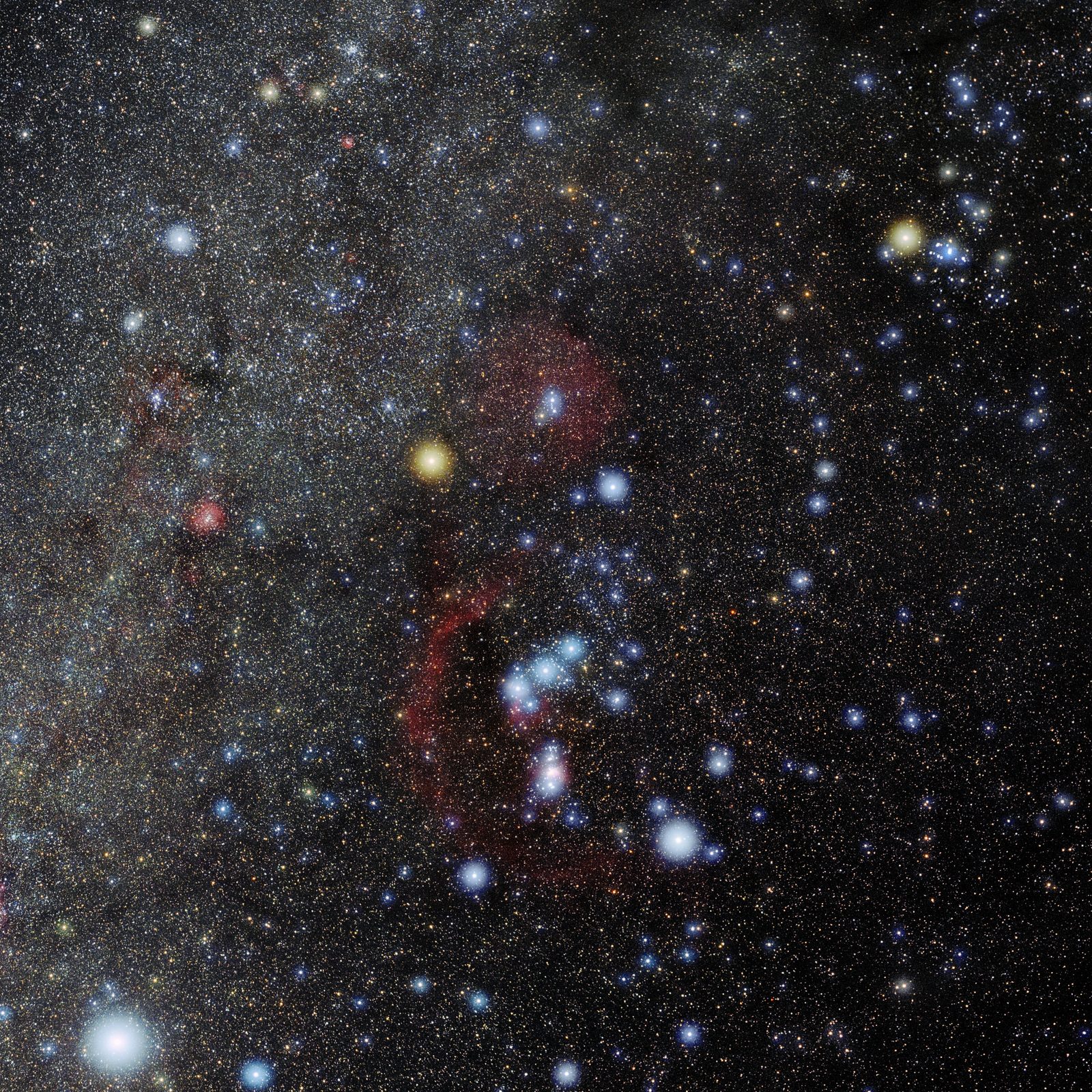
Now the story. Its arrow is that row of three. The Aitareya Brahmana tells it in a few lines and softens none of it. Prajapati, the lord of creatures, went after his own daughter, and became a stag to do it, and she a doe. The gods could not have it. They put their most terrible parts together into one figure, Rudra, and Rudra shot the stag. Then the text points at the sky and says that is where all of them went.
They are all there. The stag is the great figure you are looking at, the one the older texts simply call Mriga, the deer. His head is the triangle you have found. The arrow is the belt, which the Brahmana calls an arrow in three pieces, and it is still in him. The hunter is Sirius, whose old Sanskrit name is Mrigavyadha, the deer-piercer; in the middle of August he comes up at 4:15 and barely clears the rooftops before the sky starts to lighten. And the doe is Rohini, the red star, up before any of them. That is not the story I told about her last month, which was the moon's story and a much gentler one. This one is older and it does not go out of its way to be pleasant. Hold it loosely, with your eyes on the object.
The name is the best thing here. Mṛga (मृग) is usually translated deer, and it is wider than that. It covers the whole class of wild hoofed animals a person might go out after: blackbuck, chital, the antelope of the dry country. Śiras is head. So far, plain description: somebody looked at three faint stars above two bright ones and saw an animal looking back.
Then the word starts working. From mṛga comes the verb mṛg, and it does not mean to be a deer. It means to hunt, to chase, to look for, to search through, to investigate. Mṛgayā (मृगया) is the hunt itself. And mārga (मार्ग), which you know as marg, the word on the signboard at the end of your road, is on the standard reading formed from mṛga: first the track of a wild animal, then any track, then a road, then a method, then a way of doing anything at all. (A few scholars have argued against that derivation. The dictionaries have kept it.)
Read the sequence out. The animal. The looking for the animal. The path that the looking wears into the ground. Roads begin as searches, and the word remembers it.
These same three stars are a station in the Chinese system too, the Turtle Beak, one of the smallest of that system's 28 mansions. Two traditions, working separately, drew a boundary around this weak little triangle when there were far brighter stars a few degrees below it. A station is not a prize for brightness. It is an address on the road the moon takes, and an address does not have to be well lit.
The presiding figure here is Soma (सोम), which is one of the moon's names and also the pressed plant of the hymns. Nobody now knows which plant. Two centuries of scholars have offered ephedra, a mushroom and a dozen others, and the question is open. So the station people call the station of searching has, for its deity, the one substance in the oldest hymns that is still being looked for. I have no doctrine to build on that. I just like knowing it at four in the morning.
That searching reading comes from the handbooks and from the picture, not from any early text I can put in your hand. I think the picture earns it, but only if you have watched a deer. A deer's eyes are set on the sides of its head, not the front. It sees about 300 degrees around itself; we manage a little under 200. Its ears turn separately, one forward and one back at once. The head keeps turning because the animal is prey, and because what it needs to know is behind it as often as in front. That is not nerves. It is the work.
So a head that keeps turning is a head that has not settled, and the tradition reads that as looking for something. What I would offer, as an offer and not a verdict, is that a reading built here is about the search rather than the thing at the end of it. The questions are plain. What am I actually looking for. Would I know it if it were in front of me. How much of the looking do I enjoy for its own sake. Some people search because they want the thing; some because searching is the part they like, and a life built on the second is not a failed version of the first. No table can tell you which you are. You can tell yourself in about 10 minutes, and that is the sort of question worth bringing.
So: a morning between the 13th and the 24th, past the last streetlight by three, facing east and in no hurry. The horizon hands up the head first and the arrow after it; you will collect them the other way round, the bright before the faint. Half a fist above the orange star, then, into what looks like nothing. Give it the minute it asks for.
Twice a week
Essays like this one, Tuesdays and Saturdays. One email per essay, and the archive is never mailed out. Subscriptions open shortly; the RSS feed is live now.
Nothing else arrives, ever.