The two-clock kitchen
Two clocks on a kitchen wall, one for Chicago and one for Chennai, ten and a half hours apart. The daily arithmetic of a household keeping two days at once.
Two ways in. The gist assumes you have never met any of this before.
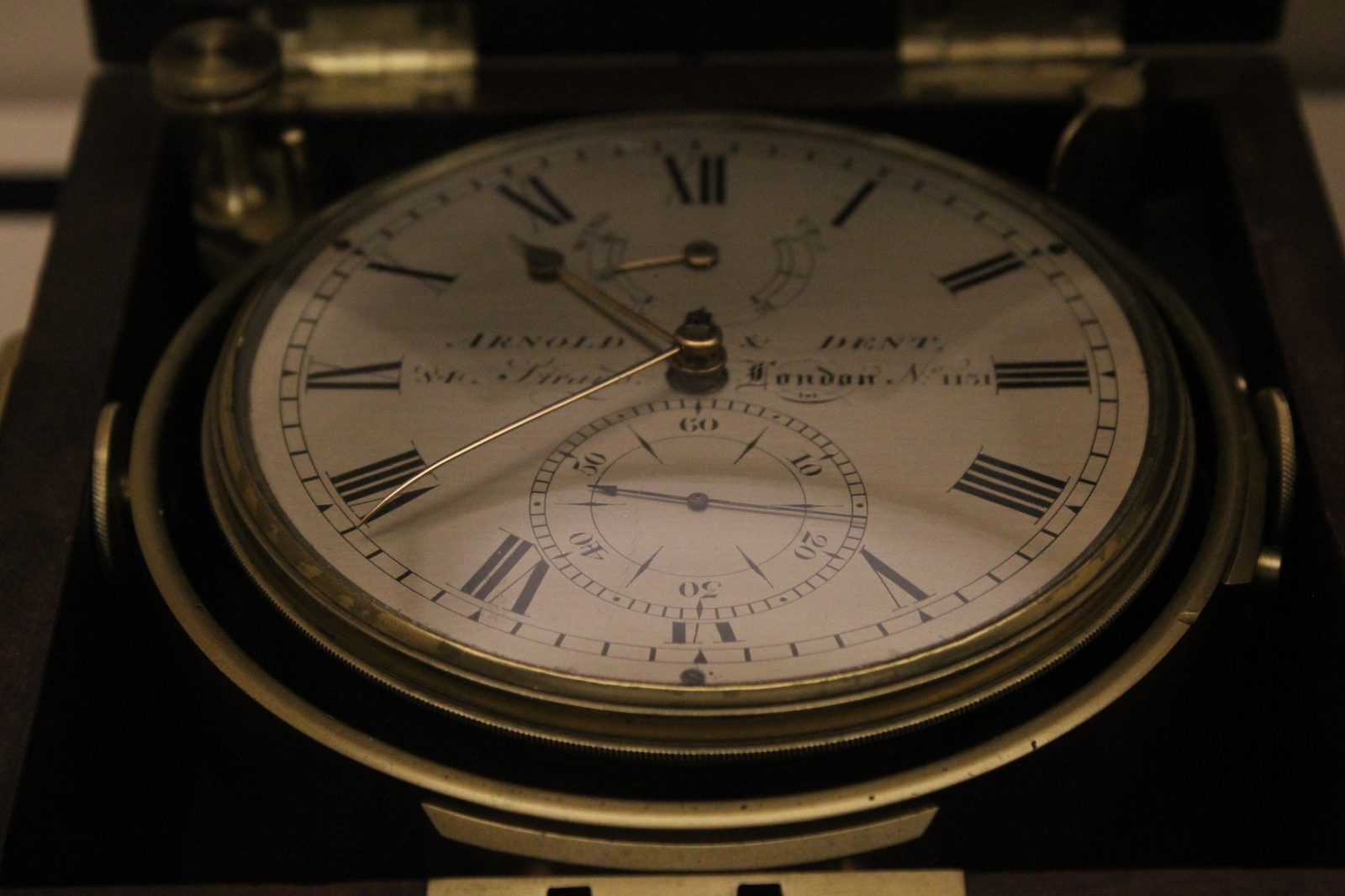
A kitchen that keeps two clocks, one for the city the family lives in and one for India, is running a gap that always ends in 30 minutes and that moves twice a year without India moving at all. Take the pair as Chicago and Chennai: the Chennai clock is ten and a half hours ahead from March to November and eleven and a half hours ahead for the rest of the year.
The kitchen is a composite and so is the household in it. A great many families have arrived at the same arrangement separately, which is why the arrangement rather than any one of them is the part worth looking at. Often the second clock is not a clock. It is a widget on a phone, or a wristwatch in a drawer that was never reset after the last visit, or a strip of paper taped inside a cupboard door with two columns of hours on it in biro.
Start with the half hour, because it is the part that never becomes automatic. India keeps one clock for the whole country, five and a half hours ahead of Greenwich, reckoned from the meridian at 82 degrees 30 minutes east and fixed there on 1 January 1906. What that meridian does to the sun over any particular Indian town is worked out in why the sundial and the clock disagree. What it does to this kitchen is blunter. Nearly every other country sets its clock a whole number of hours from Greenwich, so whatever the gap on this wall happens to be, it will always end in 30 minutes.
Whole hours can be done with the eyes shut. Half hours have to be carried. Nine in the morning here is half past seven in the evening there, and the seven arrives at once while the thirty is the piece that goes missing at the end of a tiring day. Families who have moved the other way have their own version of it: Nepal sets its clocks 15 minutes ahead of India's, so the arithmetic in a Kathmandu kitchen runs in quarters.
The heavier trouble is not the hour, though. It is the date. From March to November, eight in the morning in Chicago is half past six in the evening in Chennai. At half past one in the afternoon here, midnight passes there, and everything after that belongs to tomorrow. Sunday morning at home is Saturday evening in this kitchen. The hour is a sum and a sum can be checked. The day is a jump, and nothing on a clock face records that it has happened.
So the calls get planned backwards, from the other household's day rather than from this one. A call before work here catches the end of the evening there, which is a good hour for talking and a poor one for asking anybody to go and look for a document. A call at nine at night here lands at half past seven the next morning there, early, but not too early for a house that has always been up at five. Every two-clock household has one person who holds all of this, and that person does not experience it as arithmetic. They are thinking about whether the tablets have been taken, whether a phone ringing now would be welcome or would startle somebody who sleeps badly, whether Tuesday at the other end is a working day for the cousin who might be asked for help. The conversion is the small part. The picture of the other household is what the conversion is for.
Twice a year the gap itself moves, and only one end of it does the moving. American clocks go forward on the second Sunday in March and back on the first Sunday in November, under rules set by a law of 2005 that took effect in 2007. British and European clocks move on the last Sunday of March and the last Sunday of October. India moves on no Sunday at all. So this wall reads ten and a half hours for about eight months and eleven and a half for the other four, and the household has to notice the change twice, unprompted, in a week when it is thinking about other things.
Add a third country and the pattern gets finer. In 2026 the American clocks went forward on 8 March and the British ones on 29 March. For those three weeks the gap between Chicago and London was five hours rather than the six it holds for the rest of the year, while the gap from each of them to Chennai was whatever it was. A family spread across the three cities had a set of memorised numbers of which one had quietly stopped being true. Nobody announces this. Somebody works it out again from scratch, usually while holding a phone.
Some of what this kitchen does is timed to the far clock on purpose. On 7 November 2026 the sun goes down in Chennai at 5.41 in the evening. Chicago is on standard time by then, eleven and a half hours behind, so that sunset falls at 6.11 on the Chicago morning. A household that wants its lamp lit at the hour the lamp at home is lit will be lighting it in the dark, before anybody has left for school, and will then go to work.
Which date an observance falls on is a separate question and a much larger one. A pañcāṅga (पञ्चाङ्ग), the Indian almanac sheet, gives the tithi (तिथि), the lunar day that most observances are pinned to, and it works out the day's boundaries for one named city, which is why the sheet made for Chennai and the sheet made for Chicago can honestly print two different dates. I took one case of that apart in your festival, eight thousand kilometres later. The hour is the smaller decision, and it is the one this kitchen makes far more often. Keeping the hour they keep at home is a proper answer. Keeping the hour your own sheet gives you is a proper answer. The useful thing is to know which of the two your house is using, since a family can hold one of them for the festival and the other for the monthly fast without ever noticing that it has.
Sooner or later a child in this kitchen asks which of the two clocks is the real time.
It is a fair question and the honest answer takes a moment. Neither of them is the time, and both of them are correct. There is one instant, and the two faces are two names for it, in the way that one distance can be given in kilometres or in miles. The phone in your pocket makes the point tidily: it keeps a single running count of seconds and draws two dials out of it.
That is true, and it is not much use to a nine year old. The better answer is that the second clock is not there to tell you the time. It is there to tell you what is happening in a house you know. Whether the kitchen at the other end is busy. Whether the front door has been locked for the night. Whether the person you want to speak to has had their tea yet. Read that way it is not a clock; it is a household, kept on the wall in a form that can be glanced at while you are doing something else.
People who live with two clocks get good at this, and the skill stays invisible because it looks like nothing at all. Adding ten and a half hours and subtracting a day, twice before breakfast, is not hard. Doing it right every time for twenty years, while tired, while cooking, while conducting the rest of your life in a second language, is a real competence, and it has never once been thanked. Where it fails is predictable. Not on the hour, which is easy. On the 30 minutes, on the date, and in the fortnight after one country has changed its clocks and the other has not.
Two small things make it steadier, and both take about five minutes. The kitchens where it goes wrong least often have a city written on each clock rather than home and here, since those two words stop meaning anything the moment somebody in the family moves again, and a strip of paper taped under the far clock with the day of the week on it in pencil.
From half past one in the afternoon here until the Chicago clock reaches midnight, the wall carries two dates at once. In that stretch the far house goes from dark to the middle of its morning and this one goes from lunch to bed, and the strip of paper under the second clock is the only thing in the room that says so.
Twice a week
Essays like this one, Tuesdays and Saturdays. One email per essay, and the archive is never mailed out. Subscriptions open shortly; the RSS feed is live now.
Nothing else arrives, ever.