Computed sky · Meghnad Chitnis
Why the sundial and the clock disagree
A sundial and a clock drift apart and back again through the year. The equation of time worked by hand, its two causes separated and then added.
Two ways in. The gist assumes you have never met any of this before.
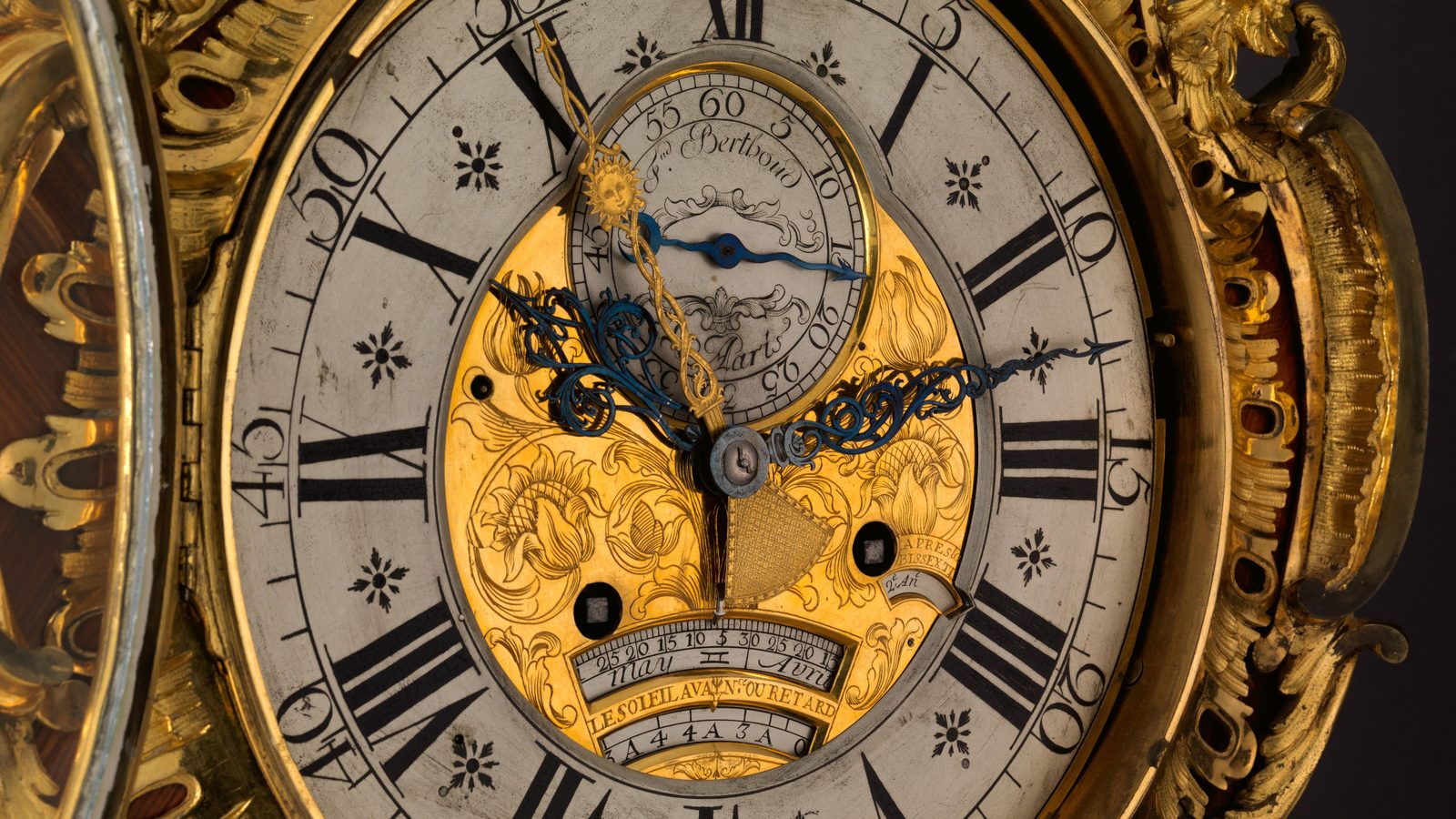
A sundial and a clock set for the same meridian agree on four days of 2026 and disagree on the other 361, by as much as 16 minutes 27 seconds. Neither of them is wrong. The gap has three separate causes, and only the third, the equation of time, is about the sky.
The other two go quickly. The first is politics: India keeps one clock, five and a half hours ahead of Greenwich, reckoned from the meridian at 82° 30′ east. A country is entitled to do that, and it says nothing about the sun over any particular town.
The second is geography, and it is fixed arithmetic. The earth turns 15 degrees an hour, so one degree of longitude is 4 minutes of time. The Jantar Mantar at Jaipur stands at 75° 49′ east, 6° 41′ west of that meridian. Multiply by 4: the sun reaches Jaipur 26 minutes 44 seconds late, and the great masonry dial there runs that much behind Indian Standard Time, in 1735 and in 2135 alike. Both corrections sit inside the pipeline that turns a birth moment into a chart.
Take those two away and the leftover is not fixed: it swells and shrinks through the year and returns to where it began twelve months later. The word equation in its name is the medieval one, from aequatio, meaning a correction and not an equals sign.
Two definitions, then the arithmetic. Apparent solar time is what the shadow keeps: noon in it is the moment the sun crosses your meridian. Mean solar time is what a clock keeps, and it runs on an invented sun that goes round at a perfectly even rate and has no other virtue at all. The equation of time is the first minus the second, the Naval Observatory's sign convention, so a plus means the shadow is ahead.
Now the split, which is the idea of this page. Call the mean sun's position L, the even-running number a clock is built on; the real sun's position along the ecliptic λ; its position round the equator α. The equation of time is L − α. Put λ into the middle of that, once with a minus and once with a plus:
L − α = (L − λ) + (λ − α)
Nothing is lost and nothing is counted twice. The first bracket knows only that the orbit is an ellipse, the second only that the axis is tilted. So work them one at a time.
The orbit is an ellipse
The earth's orbit has an eccentricity of 0.01670, a very mild ellipse. The earth is nearest the sun in early January, furthest in early July, and travels faster when it is nearer, so the real sun runs ahead of an evenly moving one for half the year and behind it for the other half.
That gap is the equation of the centre, and for an orbit this close to a circle it is a short series. M is the mean anomaly, the angle covered from perihelion at an even rate, a little under a degree a day:
C = 1.9133° sin M + 0.0200° sin 2M
Both coefficients fall out of the eccentricity and nothing else. The first is 2e in degrees: 2 × 0.01670 = 0.03340 radians, times 57.2958 degrees to the radian, so 1.9133. The second is 1.25e², or 0.000349 radians, which is 0.0200 degrees. The next term is three ten-thousandths of a degree and I drop it.
The bracket (L − λ) is minus C. Its largest value in time is 1.9133 × 4 = 7.653 minutes, or 7 minutes 39 seconds, reached when M is 90 degrees and again at 270, in early April and early October, and zero at perihelion and aphelion. One smooth swing a year.
The axis is tilted
Now suppose the orbit were a perfect circle and the sun did move along the ecliptic at an even pace. A clock would still disagree with the shadow, because a clock measures the turning of the earth, and the earth turns about its own axis rather than about the plane of its orbit. The two planes stand 23° 26′ apart.
A point at ecliptic longitude λ has a right ascension α given by one relation:
tan α = cos ε × tan λ
Here ε is the obliquity, 23° 26′ 09″ for 2026. Near the equinoxes the ecliptic crosses the equator at its steepest, so part of the sun's eastward travel is spent going north or south and α gains on λ slowly. Near the solstices the ecliptic runs parallel to the equator, all of the travel counts, and α gains fast. That is the entire mechanism.
Expanded, the difference is another short series built on one number. Half the obliquity is 11° 43′ 05″, whose tangent is 0.20742. Square it: 0.043022, and that many radians is 2.4650 degrees.
λ − α = 2.4650° sin 2λ − 0.0530° sin 4λ + 0.0015° sin 6λ
Its largest value is 2.4650 × 4 = 9.860 minutes, or 9 minutes 52 seconds, reached at 45, 135, 225 and 315 degrees of longitude, in early February, May, August and November, and zero at the equinoxes and the solstices. Look at the 2λ: this term goes round twice a year, so it has four turning points against the ellipse's two.
Both at once
One date, worked in full. Take 3 November 2026 at zero hours Universal Time. Its day number is 2,461,347.5, built by the four steps in the day number essay. The low-precision solar formulas count from noon on 1 January 2000, day number 2,451,545.0, so n = 9,802.5 days.
M = 357.529° + 0.98560028 n. That multiplication gives 9,661.348, and adding 357.529 gives 10,018.877. Take out 27 whole turns, which is 9,720, and M = 298.877°.
L = 280.466° + 0.98564737 n. That gives 9,661.809, and adding 280.466 gives 9,942.275. Take out the same 27 turns and L = 222.275°.
The ellipse. sin 298.877° = −0.87578, and sin 597.754° is sin 237.754°, which is −0.84596. So C = 1.9133 × (−0.87578) + 0.0200 × (−0.84596) = −1.69257°. The bracket is minus that, and 4 minutes to the degree gives +6.770 minutes, or 6 minutes 46 seconds.
The tilt. The sun's true longitude is λ = L + C = 220.582°. Then 2λ is 81.164° with sine 0.98823, 4λ is 162.328° with sine 0.30347, and 6λ is 243.492° with sine −0.89487. So λ − α = 2.43598 − 0.01608 − 0.00134 = 2.41856°, which is +9.674 minutes, or 9 minutes 40 seconds.
Add the two: 16.444 minutes, 16 minutes and 27 seconds. Both causes are pushing the same way, and that is the widest the year gets.
Nine dates through 2026, each worked the same way, at zero hours Universal Time:
| Date | Ellipse | Tilt | Equation of time |
|---|---|---|---|
| 1 Jan | +0m 22s | −3m 42s | −3m 20s |
| 11 Feb | −4m 45s | −9m 26s | −14m 12s |
| 15 Apr | −7m 31s | +7m 22s | −0m 09s |
| 14 May | −5m 55s | +9m 34s | +3m 39s |
| 13 Jun | −2m 49s | +2m 49s | 0m 00s |
| 26 Jul | +2m 36s | −9m 10s | −6m 34s |
| 1 Sep | +6m 20s | −6m 30s | −0m 10s |
| 3 Nov | +6m 46s | +9m 40s | +16m 27s |
| 25 Dec | +1m 20s | −1m 09s | +0m 12s |
Those nine were not chosen at random. Four are the days the causes cancel, the 13 June row most exactly of all: in 2026 the crossings fall on 15 April at 15:25, 13 June at 00:21, 1 September at 12:21 and 25 December at 09:22, Universal Time. Four are the year's turning points: 11 February, 14 May, 26 July and 3 November, and published tables give those extremes as −14m 15s, +3m 41s, −6m 30s and +16m 25s, agreeing with the column above to a few seconds. All eight dates wander by about a day across the four-year leap cycle and no further.
One note on the split. Shorter accounts calculate the tilt term from the mean longitude L instead of the true longitude λ. That is tidier to draw, but the Naval Observatory warns it makes the two effects not quite additive: the curves miss each other by a fraction of a minute. Worked from λ, as above, they add exactly.
Nothing above mentions where you are standing: no latitude and no longitude. At a given instant the equation of time is the same over Jaipur, over Reykjavik and over a ship in the Bay of Bengal, which is why an old dial could carry its correction table engraved on the plinth.
The tradition made the same division and named the halves: bhujāntara (भुजान्तर) is the correction for the ellipse and udayāntara (उदयान्तर) the one for the tilt, the second credited to Bhāskara II, and what a printed panchang does with either belongs to the almanac shelf rather than to this page.
The arithmetic is also finer than the shadow it corrects. The straight-line formulas for L and M ignore the tug of the moon and the planets, and the mean equinox is not quite the true one, which costs under two seconds between them. The sun's disc, meanwhile, is half a degree wide, so a shadow's edge takes about two minutes to sweep past a mark. The Jaipur dial is graduated in two-second divisions, which you read by judging the middle of the blur.
None of that makes the dial wrong. When the Jaipur instrument was built in the 1730s the year's two extremes stood about 20 seconds further apart than they do now, and the shadow was no more at fault then than it is today. It is not slow. It is keeping an appointment with a sun that does not run on time, and the clock on your wrist is keeping one with a sun that was invented so that it would.
Twice a week
Essays like this one, Tuesdays and Saturdays. One email per essay, and the archive is never mailed out. Subscriptions open shortly; the RSS feed is live now.
Nothing else arrives, ever.