The several ages of the Surya Siddhanta
A book that dates its own revelation to more than two million years ago, and whose received text was fixed by a commentator in 1603. Both ages are real.
Two ways in. The gist assumes you have never met any of this before.
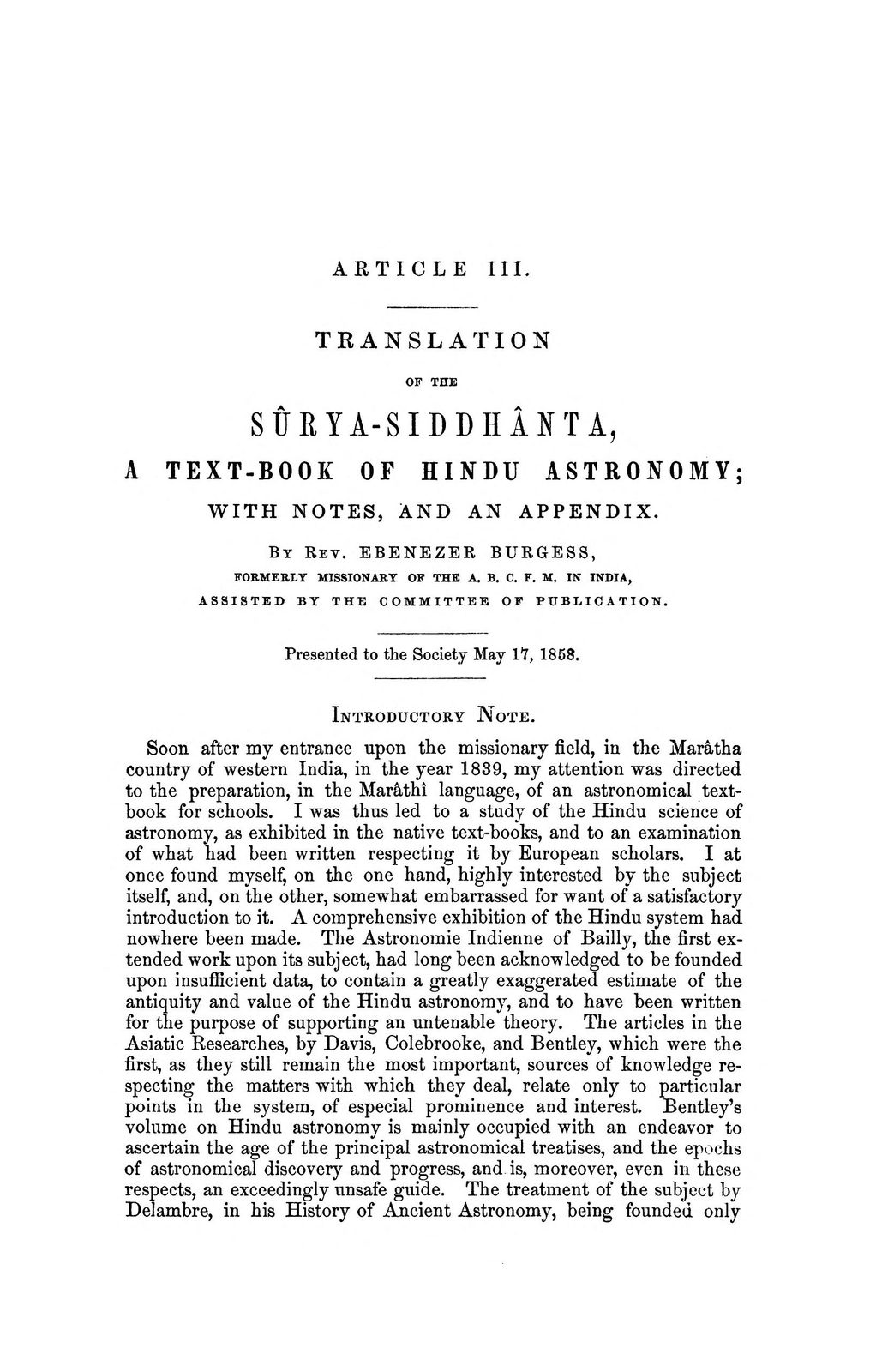
The Surya Siddhanta (सूर्यसिद्धान्त) dates its own revelation to the end of the kṛta yuga (कृतयुग), the golden age, which, by the arithmetic set out in its own first chapter, puts that moment more than 2,164,960 years before any reader who has ever held the book. The earliest outside witness to a book of that name is a sixth-century astronomer whose numbers are not the numbers our copies carry, and that difference is what dates the version we have; the shape of the text now sold under the title was settled by a commentator working in 1603. The distance between the age the book claims and the age its numbers support is the subject here, and it is not an embarrassment to be explained away. It is the machinery that kept the book in use.
Begin where the text begins. Little of the golden age is left. A great asura named Maya, wishing to know the science that causes the motion of the heavenly bodies, performs severe austerities in propitiation of the Sun. The Sun is gratified and answers that no one is able to endure his brilliance and that he has no leisure for the telling, so a person who is a part of him will relate the whole. That part takes a form Maya can stand in front of, tells him to listen with concentrated attention, and then says the sentence this essay is about: this is the very same text-book the Sun promulgated of old, and only, by reason of the revolution of the ages, is there here a difference of times. I am paraphrasing chapter 1, verses 2 to 9, from Ebenezer Burgess's English of 1860.
Read as devotion, that ninth verse is a modest formula. Read as bookkeeping it is a licence, and an unusually explicit one: it grants in advance that this text may differ from earlier texts of the same name and still be the same revelation. The commentary agrees, and says how. In each successive age the motions alter a little, so a fresh telling by the Sun is required; and even inside one age, when observed motion drifts from the data given, one applies a correction called bīja (बीज), seed. Burgess, printing all this, said he could not help suspecting in the ninth verse "a virtual confession on the part of the promulgators of this treatise" that other texts of the name were in circulation. He may be right, and the verse may still be devotion. A frame story and a working licence can share a line without either being a fraud.
The book those verses introduce is not mystical for a moment afterwards. It runs to 14 chapters: mean motions, then true places, then direction, place and time; lunar eclipses, solar eclipses, and the drawn figure by which an eclipse is laid out on a prepared surface; conjunctions of the planets, positions of the asterisms, risings and settings, the moon's phases, the armillary sphere and the other instruments, and last a short chapter on the nine modes of reckoning time. The verse is the ordinary shloka, two lines of two eight-syllable halves, serviceable rather than beautiful. Its opening totals are the ones from which the classical count of days is worked. In the form that Ranganatha of Kashi accepted and fixed in his commentary of 1603, Burgess counted exactly 500 verses, and observed that a number that round is not an accident: somebody had worked the treatise into that compass on purpose.
The book Varahamihira had
Around the middle of the sixth century, Varahamihira condensed five astronomical systems into one work, the Pañcasiddhāntikā (पञ्चसिद्धान्तिका), and gave the first place among them to a Saura siddhanta, a treatise of the Sun. His summary survives. The system it summarises does not, except through him, and his numbers are not the numbers of the text we have.
A parameter, in this literature, is a figure the tables stand on: how many revolutions a planet makes in a stated period, or how many civil days a text assigns to a Great Age of 4,320,000 years. On that last one the two books separate. The Saura that Varahamihira condensed works out to 1,577,917,800 days in the Great Age. The received Surya Siddhanta gives 1,577,917,828. A gap of 28 days inside four million years is nothing at all to a person consulting an almanac, and everything to a person asking which book he is holding. The older figure, moreover, matches a lost midnight-reckoning work of Aryabhata and the tradition that descends from it. So the name stayed put while the contents changed families.
That leaves the age a reader most wants and this essay has so far withheld: the date of the text itself. Scholarship argues about it and has not finished. The received version is usually placed at about the ninth century or later, a revision made under an inherited title rather than the book Varahamihira was summarising, and competent people defend dates on either side of that. A range is the honest form of the answer, and what follows is why it will stay one.
That is the pattern, and the tradition had a name for the part of it that could be admitted openly. Bija corrections adjust the inherited revolution counts by small amounts, without anyone claiming to correct the Sun. Sometimes they were kept outside the text, in the practitioner's working rules. Sometimes they got in. An edition of the Surya Siddhanta rendered into Bengali and printed at Calcutta in 1896 carries 21 additional stanzas in chapter 14, between verses 23 and 24, entirely concerned with applying bija to the mean places the book itself has just taught you to compute. Ranganatha, three centuries earlier, had gone the other way and thrown material out, rejecting certain stanzas as interpolation, among them one that Burgess found sitting after chapter 1, verse 6 in the manuscripts he owned that carried no commentary.
Notice what none of that requires. No forger, no conspiracy, no moment at which somebody decided to deceive. A revealed book has no author to contradict, no death date after which additions become impossible, and no title page whose claims a later reader can check. Verse nine has already told you the data may differ. An astronomer who finds the moon arriving late can therefore mend the number he uses and go on calling the book by its name, and the next copyist, finding the mended number in his exemplar, has no way to tell that it is new. An authored book cannot behave like this. Varahamihira's works freeze at his death and acquire commentaries around the outside, which is why they can be dated and why they went out of date.
What print did
Ebenezer Burgess reached the Maratha country as a missionary in 1839, was set to preparing an astronomy textbook in Marathi for schools, and went from there to the Sanskrit texts themselves. He drafted his translation in India with the help of Brahman scholars, then sent the whole of his material home for revision. The notes grew there, the largest share of the work falling to William Dwight Whitney. The result was presented to the American Oriental Society on 17 May 1858 and printed in 1860, in the sixth volume of its Journal, as an article of some 350 pages, most of them notes.
The two men did not agree, and the disagreement is bound into the same covers. Whitney's notes hold that the Hindus took their astronomy very largely from the Greeks. Burgess, at the end, added a short concluding note of his own to say that he had come to other conclusions, that he thought the Hindus original in most of the elementary facts of the science, and that he intended to argue it elsewhere. A reader in 1860 therefore bought one book containing two views of how old its subject was.
That printing did something the manuscripts never could. It fixed a version. The 500 verses in Ranganatha's order, in that sequence, with those readings, became the Surya Siddhanta for everybody who reads it in English, and a fluid text acquired a stable surface at the exact moment it entered a new language.
It also stayed in service. The Serampore almanac leaf of 1825 announced on its opening page that it had been worked according to the Surya Siddhanta, and Bengal's almanac houses still divide on the question: the Vishuddha Siddhanta Panjika was founded in the Bengali year 1297, that is 1890, precisely because the older reckoning no longer agreed with the observed sky, and the older houses carried on regardless, as some of them do now.
So a reader today can hold three Surya Siddhantas at once. There is the one Varahamihira condensed, which exists only as somebody else's summary and gives 1,577,917,800 days to the Great Age. There is the one Ranganatha fixed and Burgess printed, 500 verses long, with its 28 extra days and its interpolated stanza expelled. There is the one a panjika masthead names this year, still guaranteeing a set of tables to somebody buying an almanac. They are cousins sharing a name, and each of them was, at its own moment, the ancient book. It stayed ancient by never staying the same.
Twice a week
Essays like this one, Tuesdays and Saturdays. One email per essay, and the archive is never mailed out. Subscriptions open shortly; the RSS feed is live now.
Nothing else arrives, ever.